![CrystalCave2<span style="color:red;">[NEW]</span>](https://img.youtube.com/vi/HfcU-A432yE/maxresdefault.jpg)


Saint Louis & Saint Joseph Calasanz
Lives of the Saints
by Alban Butler, Benziger Bros. edition
[1894]
August 25.—ST. LOUIS, King.
THE mother of Louis told him she would rather see him die than commit a mortal sin, and he never forgot her words.
King of France at the age of twelve, he made the defense of God’s honor the aim of his life. Before two years, he had crushed the Albigensian heretics, and forced them by stringent penalties to respect the Catholic faith.
Amidst the cares of government, he daily recited the Divine Office and heard two Masses, and the most glorious churches in France are still monuments of his piety.
When his courtiers remonstrated with Louis for his law that blasphemers should be branded on the lips, he replied, “I would willingly have my own lips branded to root out blasphemy from my kingdom.”
The fearless protector of the weak and the oppressed, he was chosen to arbitrate in all the great feuds of his age, between the Pope and the Emperor, between Henry III. and the English barons.
In 1248, to rescue the land which Christ had trod, he gathered round him the chivalry of France, and embarked for the East. There, before the infidel, in victory or defeat, on the bed of sickness or a captive in chains, Louis showed himself ever the same,—the first, the best, and the bravest of Christian knights.
When a captive at Damietta, an Emir rushed into his tent brandishing a dagger red with the blood of the Sultan, and threatened to stab him also unless he would make him a knight, as the Emperor Frederick had Facardin. Louis calmly replied that no unbeliever could perform the duties of a Christian knight.
In the same captivity he was offered his liberty on terms lawful in themselves, but enforced by an oath which implied a blasphemy, and though the infidels held their swords’ points at his throat, and threatened a massacre of the Christians, Louis inflexibly refused.
The death of his mother recalled him to France; but when order was reestablished, he again set forth on a second crusade. In August, 1270, his army landed at Tunis, and, though victorious over the enemy, succumbed to a malignant fever. Louis was one of the victims. He received the Viaticum kneeling by his camp-bed, and gave up his life with the same joy that he had given all else for the honor of God.
Reflection.—If we cannot imitate St. Louis in dying for the honor of God, we can at least resemble him in resenting the blasphemies offered against God by the infidel, the heretic, and the scoffer.
Saint Louis; Saint Joseph Calasanz, Priest Ru 1:1, 3-6, 14b-16, 22/Mt 22:34-40 (423).
https://www.ewtn.com/catholicism/saints/louis-ix-of-france-672
CATHOLICISM SAINTS ST. LOUIS IX OF FRANCE
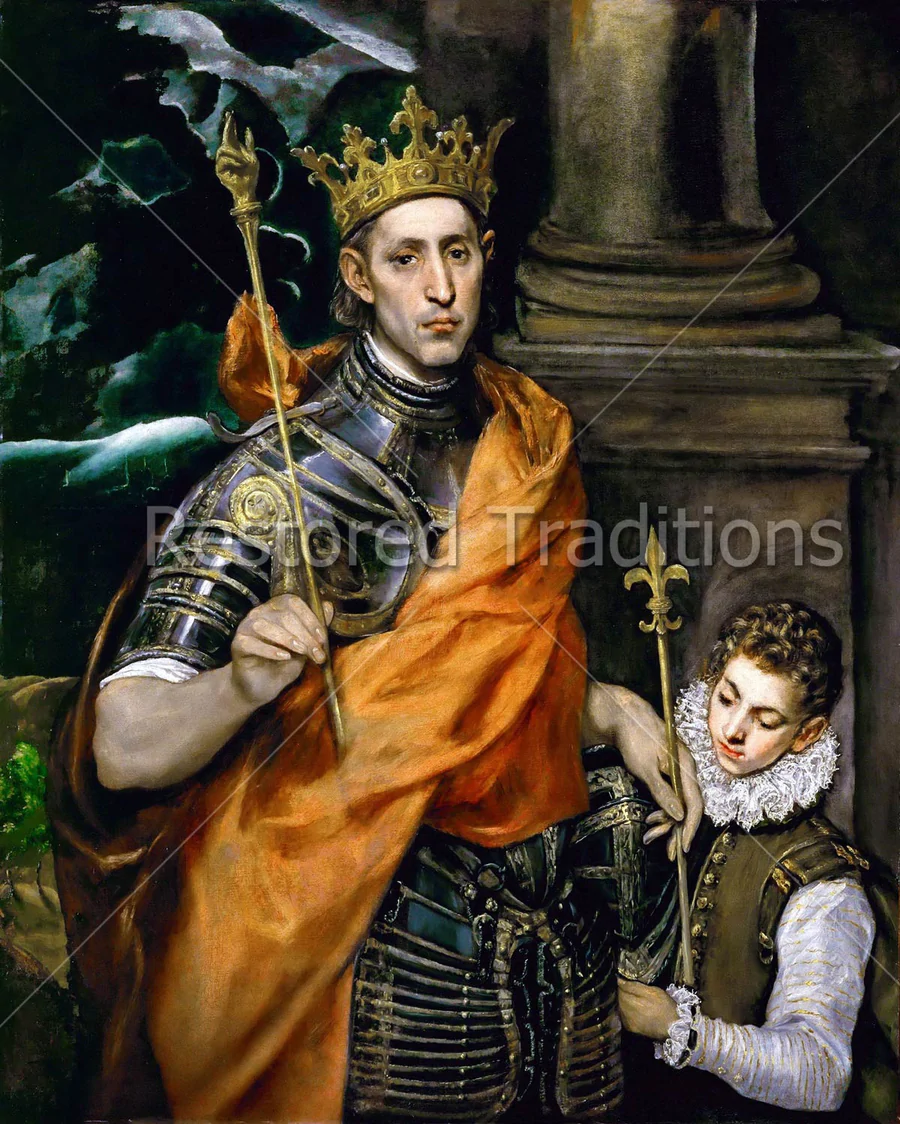
*St Louis of France – Greco.
This is a portrait of the thirteenth-century French king, Saint Louis. St. Louis participated in the Crusades and was devoted to the welfare of his people. He is the Patron Saint of Religious Tertiaries. Artwork by El Greco.
Louis IX (25 April 1214 – 25 August 1270), commonly known as Saint Louis or Louis the Saint, was King of France from 1226 to 1270, and the most illustrious of the Direct Capetians. He was crowned in Reims at the age of 12, following the death of his father Louis VIII. His mother, Blanche of Castile, ruled the kingdom as regent until he reached maturity, and then remained his valued adviser until her death. During Louis’ childhood, Blanche dealt with the opposition of rebellious vassals and secured Capetian success in the Albigensian Crusade, which had started 20 years earlier.
As an adult, Louis IX faced recurring conflicts with some of his realm’s most powerful nobles, such as Hugh X of Lusignan and Peter of Dreux. Simultaneously, Henry III of England attempted to restore the Angevin continental possessions, but was promptly routed at the Battle of Taillebourg. Louis annexed several provinces, notably parts of Aquitaine, Maine and Provence.
Louis IX enjoyed immense prestige throughout European Christendom. His reign is often remembered as an economic and political golden age for the Kingdom of France during the Middle Ages. He was largely admired by fellow European rulers and was sometimes asked to arbitrate disputes outside of his kingdom.
Louis IX reformed the French legal process, creating a royal justice system in which petitioners could appeal judgements directly to the king. He banned trials by ordeal, tried to end private wars, and introduced the presumption of innocence to criminal procedures. To enforce his new legal system, Louis IX created provosts and bailiffs.
Honoring a vow he had made while praying for recovery during a serious illness, Louis IX led the ill-fated Seventh Crusade and Eighth Crusade against the Muslim dynasties that ruled North Africa, Egypt and the Holy Land. He was captured and ransomed during the Seventh Crusade, and later died of dysentery during the Eighth Crusade. He was succeeded by his son Philip III.
His admirers through the centuries have regarded Louis IX as the ideal Christian ruler. His skill as a knight and engaging manner with the public made him popular, though contemporaries occasionally rebuked him as a “monk king”. Despite his liberalizing legal reforms, Louis was a devout Christian and enforced strict Catholic orthodoxy. He passed severe laws punishing blasphemy and targeted France’s Jews, including the burning of the Talmud after the Disputation of Paris. He is the only canonized king of France.
https://en.wikipedia.org/wiki/Louis_IX_of_France
Joseph Calasanz Sch.P. (Spanish: José de Calasanz; Italian: Giuseppe Calasanzio), (September 11, 1557 – August 25, 1648), also known as Joseph Calasanctius and Iosephus a Mater Dei, was a Spanish Catholic priest, educator and the founder of the Pious Schools, providing free education to the sons of the poor, and the religious order that ran them, commonly known as the Piarists. He was a close friend of the renowned astronomer Galileo Galilei. He is honored as a saint by the Catholic Church.

This artwork by F. Goya shows Saint Joseph Calasanz, priest and Founder of the Clerks Regular of Religious Schools, receiving the Holy Eucharist for the last time in the sight of the poor children whom he has educated.
https://en.wikipedia.org/wiki/Joseph_Calasanz
Do not conform to the pattern of this world, but be transformed by the renewing of your mind. Then you will be able to test and approve what God’s will is – his good, pleasing and perfect will.
Rom 12:2