![CrystalCave2<span style="color:red;">[NEW]</span>](https://img.youtube.com/vi/HfcU-A432yE/maxresdefault.jpg)


Saint Augustine
Saints Who Were Great Evangelizers
St. Augustine – Bishop of Hippo, a contemporary of Jerome, and another Doctor of the Church, Augustine was notorious for his life of sinful indulgence prior to his conversion. He continues to inspire people, not only because of his conversion, but also with the brilliance of his writings—most famously his Confessions—which have had a profound impact on Christian thought down to the present day.
Lives of the Saints
by Alban Butler, Benziger Bros. edition
[1894]
August 28.—ST. AUGUSTINE OF HIPPO.
- AUGUSTINE was born in 354, at Tagaste in Africa.
He was brought up in the Christian faith, but without receiving baptism. An ambitious school-boy of brilliant talents and violent passions, he early lost both his faith and his innocence. He persisted in his irregular life until he was thirty-two.
Being then at Milan professing rhetoric, he tells us that the faith of his childhood had regained possession of his intellect, but that he could not as yet resolve to break the chains of evil habit.
One day, a however, stung to the heart by the account of some sudden conversions, be cried out, “The unlearned rise and storm heaven, and we, with all our learning, for lack of heart lie wallowing here.”
He then withdrew into a garden, when a long and terrible conflict ensued. Suddenly a young fresh voice (he knows not whose) breaks in upon his strife with the words, “Take and read;” and he lights upon the passage beginning, “Walk honestly as in the day.” The battle was won. He received baptism, returned home, and gave all to the poor.
At Hippo, where he settled, he was consecrated bishop in 395. For thirty-five years he was the center of ecclesiastical life in Africa, and the Church’s mightiest champion against heresy; whilst his writings have been everywhere accepted as one of the principal sources of devotional thought and theological speculation. He died in 430.
Reflection.—Read the lives of the Saints, and you will ill find that you are gradually creating a society about you to which in some measure you will be forced to raise the standard of your daily life.
Saint Augustine, Bishop and Doctor of the Church Memorial 1 Thes 1:1-5, 8b-10/Mt 23:13-22 (425).
https://www.ewtn.com/catholicism/saints/augustine-481
CATHOLICISM SAINTS ST. AUGUSTINE
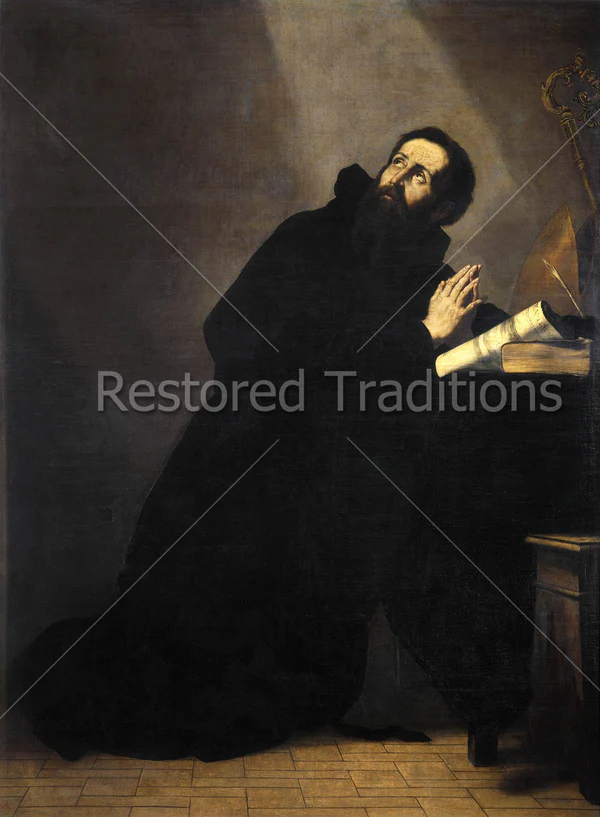
*St. Augustine in Prayer – Ribera.
The great Saint Augustine of Hippo prays to God for the light of grace. Artwork by J. Ribera.
Augustine of Hippo (/ɔːˈɡʌstɪn/, also US: /ˈɔːɡəstiːn/; Latin: Aurelius Augustinus Hipponensis; 13 November 354 – 28 August 430), also known as Saint Augustine, was a theologian and philosopher of Berber origin and the bishop of Hippo Regius in Numidia, Roman North Africa. His writings influenced the development of Western philosophy and Western Christianity, and he is viewed as one of the most important Church Fathers of the Latin Church in the Patristic Period. His many important works include The City of God, On Christian Doctrine, and Confessions.
According to his contemporary, Jerome, Augustine “established anew the ancient Faith”. In his youth he was drawn to the eclectic Manichaean faith, and later to the Hellenistic philosophy of Neoplatonism. After his conversion to Christianity and baptism in 386, Augustine developed his own approach to philosophy and theology, accommodating a variety of methods and perspectives. Believing the grace of Christ was indispensable to human freedom, he helped formulate the doctrine of original sin and made significant contributions to the development of just war theory. When the Western Roman Empire began to disintegrate, Augustine imagined the Church as a spiritual City of God, distinct from the material Earthly City. The segment of the Church that adhered to the concept of the Trinity as defined by the Council of Nicaea and the Council of Constantinople closely identified with Augustine’s On the Trinity.
Augustine is recognized as a saint in the Catholic Church, the Eastern Orthodox Church, and the Anglican Communion. He is also a preeminent Catholic Doctor of the Church and the patron of the Augustinians. His memorial is celebrated on 28 August, the day of his death. Augustine is the patron saint of brewers, printers, theologians, and a number of cities and dioceses. His thoughts profoundly influenced the medieval worldview. Many Protestants, especially Calvinists and Lutherans, consider him one of the theological fathers of the Protestant Reformation due to his teachings on salvation and divine grace. Protestant Reformers generally, and Martin Luther in particular, held Augustine in preeminence among early Church Fathers. From 1505 to 1521, Luther was a member of the Order of the Augustinian Eremites.
In the East, his teachings are more disputed, and were notably attacked by John Romanides, but other theologians and figures of the Eastern Orthodox Church have shown significant approbation of his writings, chiefly Georges Florovsky. The most controversial doctrine associated with him, the filioque, was rejected by the Orthodox Church. Other disputed teachings include his views on original sin, the doctrine of grace, and predestination. Though considered to be mistaken on some points, he is still considered a saint and has influenced some Eastern Church Fathers, most notably Gregory Palamas. In the Orthodox Church, his feast day is celebrated on 15 June. The historian Diarmaid MacCulloch has written: “Augustine’s impact on Western Christian thought can hardly be overstated; only his beloved example, Paul of Tarsus, has been more influential, and Westerners have generally seen Paul through Augustine’s eyes.
https://en.wikipedia.org/wiki/Augustine_of_Hippo
The Lord reigns, he is robed in majesty; the Lord is robed in majesty and armed with strength; indeed, the world is established, firm and secure.
Ps 93:1