![CosmicDrama5<span style="color:red;">[NEW]</span>](https://catholicartcollection.com/wp-content/uploads/2025/04/Thumbnail-0008.jpg.webp)





*Sacred Scripture* Jesus in the Carpenter’s Shop – La Tour
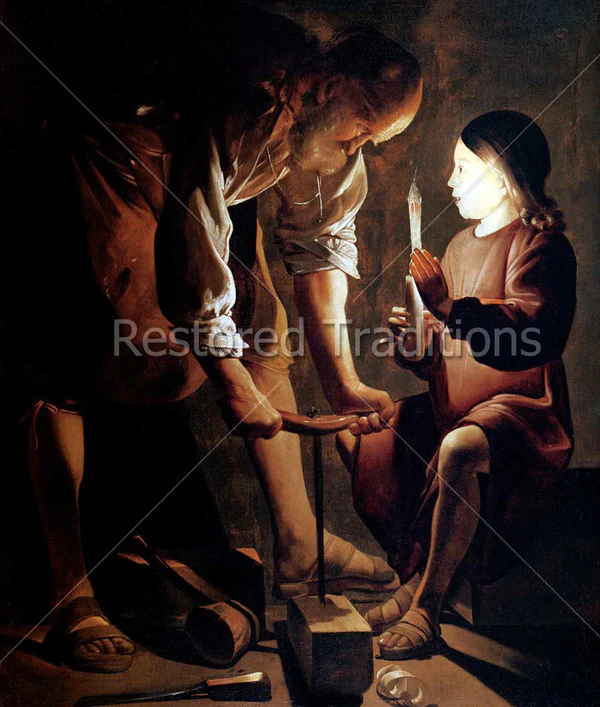
In this charming image, by French Baroque painter Georges de La Tour, St. Joseph looks at the Boy Jesus while stooping over his carpentry. The young Savior, holding a bright candle near His face, so that the light illuminates His face and Joseph’s, questions His foster father about carpentry.
Jesus, Sweep the Carpenter Shop
*On the same deep level as in the Job, in a similar vein but more complex in composition, is the Christ in the Carpenter’s Shop in the Louvre. As in the Job, one of the figures is arched over the top of the canvas, and again the attention to mood is shown in the minute observation of the effects of light in certain areas, especially that of the translucency of the child’s hand silhouetted against the candle, revealing even the dirt in the fingernails. As usual, La Tour tells the Bible story in the simplest of terms. Only items essential for identifying the subject, in this case the paraphernalia of the carpenter’s shop, are included. The picture can exist on the level of a genre scene without religious overtones, and its realism makes it one of the greatest genre paintings of the seventeenth century, rivaling Velázquez’s Water Seller of Seville and Rembrandt’s Jewish Bride (the latter has also been interpreted as a religious or mythological subject).
**As a carpenter one works late into the night. The tireless artisan chips away at wood while his devoted son holds a candle to illuminate the father’s work. Joseph the Carpenter‘s painter Georges de la Tour is a master of lighting; in his case, one speaks even of tenebrism, but sometimes labels take away from the true qualities of the artist.
The majority of La Tour’s works have a blank wall as a backdrop, against which stand his different characters, sometimes overlapping, never very many. However, the characteristic that became the principle defining element of his art is the mise-en-scene that is revealed to the spectator through an artificial light source: in the case of Joseph the Carpenter, the candle held by the child. The encircling shadows are the indispensable ploy that allows a study into the natural appearances of things.
The figure of Saint Joseph
The painter’s analysis of the child’s hand backlit by the flame combines a strongly realistic component with a mystical suggestiveness. The child we see, in fact, is Jesus, imagined helping in his old adoptive father’s shop.
The figure of Saint Joseph inhabits a notable transformative arc in iconography. For centuries he was a figure whose presence was collateral but essential. In the Nativity or in The Flight Into Egypt, the holy putative father of Christ plays a marginal role (even within the composition of the scene). One can usually find him among the shepherds, or sleeping. Sometimes he leads the donkey that carried Maria and the baby Jesus. For centuries, then, he was a character that only acted passively, obeying divine orders.
A role revisitation
Things changed when Santa Teresa D’Avila, barefoot Carmelite, dedicated her reflections to the figure of Joseph. Noting in her writings how the figure was traditionally mistreated. But she invited a revisiting of the Saint and of his role in the education of the young Jesus.
From the iconographic point of view, however, one begins to see a renewal in 1581, the year of the death of Teresa d’Avila and the start of the diffusion of her writings. Therefore, from that date on, artists began to represent Saint Joseph, sometimes inventing new scenes. And, above all in Northern European painting, they chose the environment of his carpenter’s shop. Like in Joseph the Carpenter, this became a way to represent the humility of the character, but also an everyday interior that allowed for the immediate immersion of the viewer.
http://www.joyfulheart.com/christmas/jesus_sweep.htm
The Lord has done it this very day; let us rejoice today and be glad. Lord, save us! Lord, grant us success! Blessed is he who comes in the name of the Lord. From the house of the Lord we bless you.
Ps 118:24–26