![CosmicDrama5<span style="color:red;">[NEW]</span>](https://catholicartcollection.com/wp-content/uploads/2025/04/Thumbnail-0008.jpg.webp)





*Sacred Scripture* Holy Family with Sleeping Baby – Le Brun
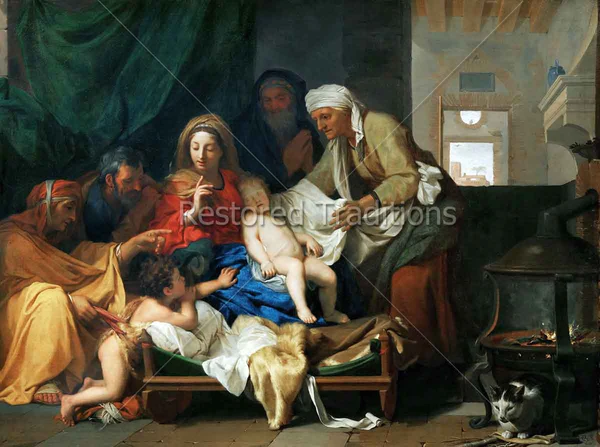
Le Brun’s painting of the Holy family and friends, in their normal every day life’s setting, was entitled “Silence” or “Sleep of the Child.” The painting’s main theme of Silence was to convey the true sense of the meaning of this moment; of true God and true man, both, taking place simultaneously within the painting’s setting and including the seven characters. (Jesus, Mary, Joseph, John the Baptist, St Anne, St Elizabeth and Zachariah).
In order to tell the story of the Incarnation of Jesus, the painting employs silence rather than words. Because words cannot adequately express or account for the completeness of divinity, the painting’s silence actually serves as a benefit.
Some have described it as “mute theology” or “mute poetry.” The Virgin Mary’s gestures are on display in the painting in achieving a suggestive quality of her communication of muteness. The other characters are in awe silently looking at the baby Jesus who is sleeping.
The Incarnation described from the Catechism of the Catholic Church: “The Word became flesh,” the Church calls “Incarnation” the fact that the Son of God assumed a human nature in order to accomplish our salvation in it. Furthermore, The unique and altogether singular event of the Incarnation of the Son of God does not mean that Jesus Christ is part God and part man, nor does it imply that he is the result of a confused mixture of the divine and the human. He became truly man while remaining truly God. Jesus Christ is true God and true man.
Yes, I like the painting’s everyday, normal story of family and friends sharing the joy of a new born baby. But, to attempt to paint on canvas for viewers, without using words, the understanding of the “not able to be truly understood” meaning of the Incarnation of Jesus Christ and actually succeeding to a fair degree is awesome!
Again, what I think Le Brun attempted to paint for viewers to understand was about the Incarnation of Jesus Christ:
By the Incarnation, it is meant that the Son of God, retaining His divine nature, took a human nature of a body and soul like ours. Jesus, the Son of God, the second person of the Trinity, became human.
Say to Daughter Zion, “See, your king comes to you, gentle and riding on a donkey, and on a colt, the foal of a donkey” . . . The crowds that went ahead of him and those that followed shouted, “Hosanna to the Son of David! Blessed is he who comes in the name of the Lord! Hosanna in the highest heaven!”
Mt 21:5, 9