![CosmicDrama5<span style="color:red;">[NEW]</span>](https://catholicartcollection.com/wp-content/uploads/2025/04/Thumbnail-0008.jpg.webp)





Saint Teresa of Avila
Lives of the Saints
by Alban Butler, Benziger Bros. edition
[1894]
October 15.—ST. TERESA.
WHEN a child of seven years, Teresa ran away from her home at Avila in Spain, in the hope of being martyred by the Moors. Being brought back and asked the reason of her flight, she replied, “I want to see God, and I must die before I can see Him.” She then began with her brother to build a hermitage in the garden, and was often heard repeating “Forever, forever” Some years later she became a Carmelite nun. Frivolous conversations checked her progress towards perfection, but at last, in her thirty-first year, she gave herself wholly to God. A vision showed her the very place in hell to which her own light faults would have led her, and she lived ever after in the deepest distrust of self. She was called to reform her Order, favored with distinct commands from Our Lord, and her heart was pierced with divine love; but she dreaded nothing so much as delusion, and to the last acted only under obedience to her confessors, which both made her strong and kept her safe. She died on October 4, 1582.
Reflection.—”After all I die a child of the Church.” These were the Saint’s last words. They teach us the lesson of her life—to trust in humble, childlike obedience to our spiritual guides as the surest means of salvation.
Saint Teresa of Jesus, Virgin and Doctor of the Church white Memorial Eph 1:15-23/Lk 12:8-12 (472).
https://www.ewtn.com/catholicism/saints/teresa-of-avila-780
CATHOLICISM SAINTS ST. TERESA OF AVILA
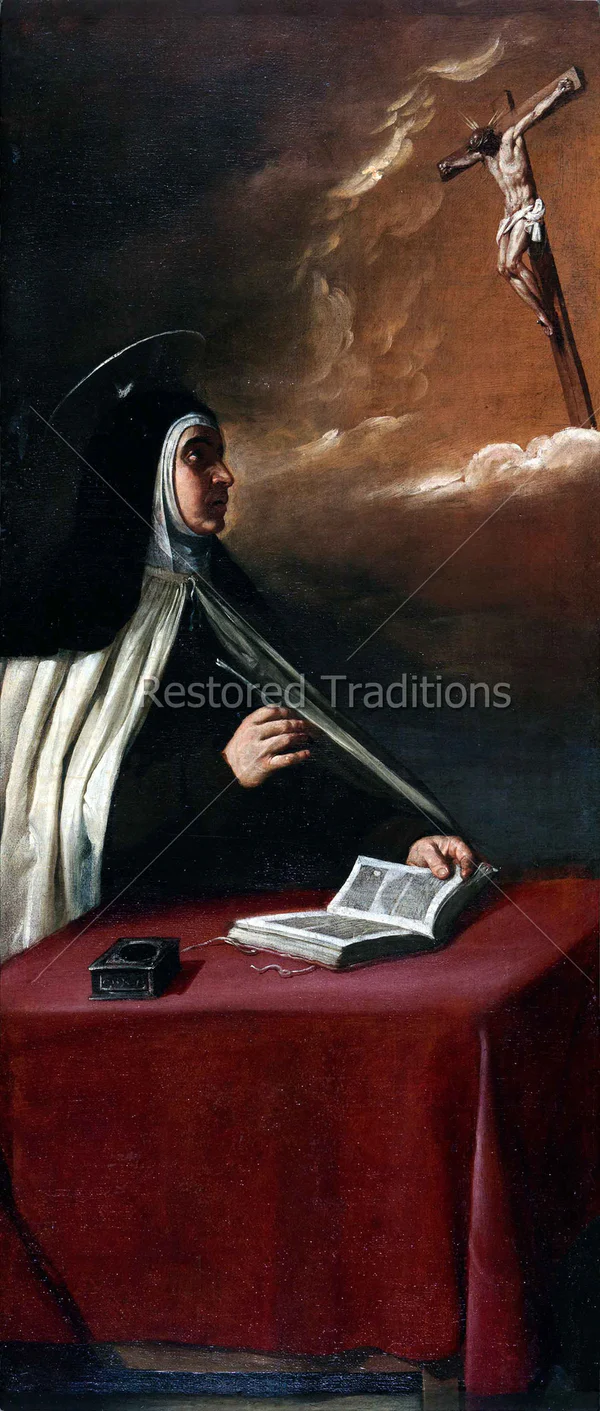
*This portrait of Saint of Teresa of Avila, by seventeen-century Spanish artist, Alonso Cano, depicts the mystic nun pausing from her writing to gaze up at a crucifix, which is suspended in the clouds.
**Teresa of Ávila (born Teresa Sánchez de Cepeda y Ahumada; 28 March 1515 – 4 or 15 October 1582), also called Saint Teresa of Jesus, was a Spanish noblewoman who was called to convent life in the Catholic Church. A Carmelite nun, prominent Spanish mystic, religious reformer, author, theologian of the contemplative life and of mental prayer, she earned the rare distinction of being declared a Doctor of the Church. Active during the Catholic Reformation, she reformed the Carmelite Orders of both women and men. The movement she initiated was later joined by the younger Spanish Carmelite friar and mystic John of the Cross. It led eventually to the establishment of the Discalced Carmelites. A formal papal decree adopting the split from the old order was issued in 1580.
https://en.wikipedia.org/wiki/Teresa_of_%C3%81vila
On hearing this, Jesus said, “It is not the healthy who need a doctor, but the sick. But go and learn what this means: ‘I desire mercy, not sacrifice.’ For I have not come to call the righteous, but sinners.”
Mt 9:12–13