![CosmicDrama5<span style="color:red;">[NEW]</span>](https://catholicartcollection.com/wp-content/uploads/2025/04/Thumbnail-0008.jpg.webp)





Saint Leo the Great
Lives of the Saints
by Alban Butler, Benziger Bros. edition
[1894]
—ST. LEO THE GREAT.
LEO was born at Rome. He embraced the sacred ministry, was made archdeacon of the Roman Church by St. Celestine, and under him and Sixtus III. had a large share in governing the Church. On the death of Sixtus, Leo was chosen Pope, and consecrated on St. Michael’s day, 440, amid great joy. It was a time of terrible trial. Vandals and Huns were wasting the provinces of the empire, and Nestorians, Pelagians, and other heretics wrought more grievous havoc among souls. Whilst Leo’s zeal made head against these perils, there arose the new heresy of Eutyches, who confounded the two natures of Christ. At once the vigilant pastor proclaimed the true doctrine of the Incarnation in his famous “tome;” but fostered by the Byzantine court, the heresy gained a strong hold amongst the Eastern monks and bishops. After three years of unceasing toil, Leo brought about its solemn condemnation by the Council of Chalcedon, the Fathers all signing his tome, and exclaiming, “Peter hath spoken by Leo.” Soon after, Attila with his Huns broke into Italy, and marched through its burning cities upon Rome. Leo went out boldly to meet him, and prevailed on him to turn back. Astonished to see the terrible Attila, the “Scourge of God,” fresh from the sack of Aquileia, Milan, Pavia, with the rich prize of Rome within his grasp, turn his great host back to the Danube at the Saint’s word, his chiefs asked him why he had acted so strangely. He answered that he saw two venerable personages, supposed to be Sts. Peter and Paul, standing behind Leo, and impressed by this vision he withdrew. If the perils of the Church are as great now as in St. Leo’s day, St. Peter’s solicitude is not less. Two years later the city fell a prey to the Vandals; but even then Leo saved it from destruction. He died A. D. 461, having ruled the Church twenty years.
Reflection.—Leo loved to ascribe all the fruits of his unsparing labors to the glorious chief of the apostles, who, he often declared, lives and governs in his successors.
Saint Leo the Great, Pope and Doctor of the Church white Memorial Phlm 7-20/Lk 17:20-25 (494).
https://www.ewtn.com/catholicism/saints/leo-the-great-669
CATHOLICISM SAINTS ST. LEO THE GREAT
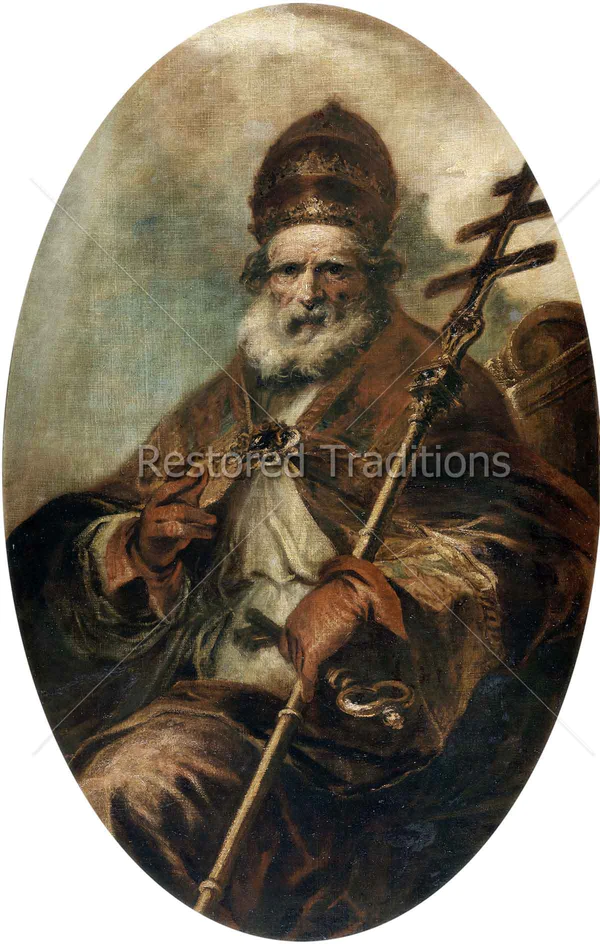
*This is a Spanish seventeenth-century portrait of Leo I, crowned with papal tiara, holding cross and key, and gazing intently while giving his blessing. The fifth-century papacy of Leo the Great was one of the most important, promoting the dignity of the papacy and political peace. Pope Leo used firm and benevolent policy to negotiate cooperation between the Western and Eastern parts of the Roman Empire, as well as with Huns and Vandals, notably going out to meet Attila as the Hun marched toward Rome. Because of his remarkable greatness at upholding the Faith in word and deed, he was made a Doctor of the Church in 1754. Artwork by F. Herrera.
**Pope Leo I (c. 400 – 10 November 461), also known as Leo the Great, was bishop of Rome from 29 September 440 until his death. Pope Benedict XVI said that Leo’s papacy “was undoubtedly one of the most important in the Church’s history.”
https://en.wikipedia.org/wiki/Pope_Leo_I
“I am the Alpha and the Omega,” says the Lord God, “who is, and who was, and who is to come, the Almighty.”
Rv 1:8