![CosmicDrama5<span style="color:red;">[NEW]</span>](https://catholicartcollection.com/wp-content/uploads/2025/04/Thumbnail-0008.jpg.webp)





*Sacred Scripture* Visitation (Mary Visiting Elizabeth) – Bloch
Lives of the Saints
by Alban Butler, Benziger Bros. edition
[1894]
—THE VISITATION OF THE BLESSED VIRGIN.
THE angel Gabriel, in the mystery of the Annunciation, informed the Mother of God that her cousin Elizabeth had miraculously conceived, and was then pregnant with a son who was to be the precursor of the Messiahs.
The Blessed Virgin out of humility concealed the wonderful dignity to which she was raised by the incarnation of the Son of God in her womb, but, in the transport of her holy joy and gratitude, determined she would go to congratulate the mother of the Baptist. “Mary therefore arose,” saith St. Luke, “and with haste went into the hilly country into a city of Judea, and entering into the house of Zachary, saluted Elizabeth.” What a blessing did the presence of the God-man bring to this house, the first which He honored in His humanity with His visit!
But Mary is the instrument and means by which He imparts to it His divine benediction, to show us that she is a channel through which He delights to communicate to us His graces, and to encourage us to ask them of Him through her intercession.
At the voice of the Mother of God, but by the power and grace of her divine Son in her womb, Elizabeth was filled with the Holy Ghost, and the Infant in her womb conceived so great a joy as to leap and exult.
At the same time Elizabeth was filled with the Holy Ghost, and by His infused light she understood the great mystery of the Incarnation which God had wrought in Mary, whom humility prevented from disclosing it even to a Saint, and an intimate friend. In raptures of astonishment Elizabeth pronounced her blessed above all other women, and cried out, “Whence is this to me that the mother of my Lord should come to me?”
Mary, hearing her own praise, sunk the lower in the abyss of her nothingness, and in the transport of her humility, and melting in an ecstasy of love and gratitude, burst into that admirable canticle, the Magnificat. Mary stayed with her cousin almost three months, after which she returned to Nazareth.
Reflection.—Whilst with the Church we praise God for the mercies and wonders which He wrought in this mystery, we ought to apply ourselves to the imitation of the virtues of which Mary sets us a perfect example. From her we ought particularly to learn the lessons by which we shall sanctify our visits and conversation, actions which are to so many Christians the sources of innumerable dangers and sins.
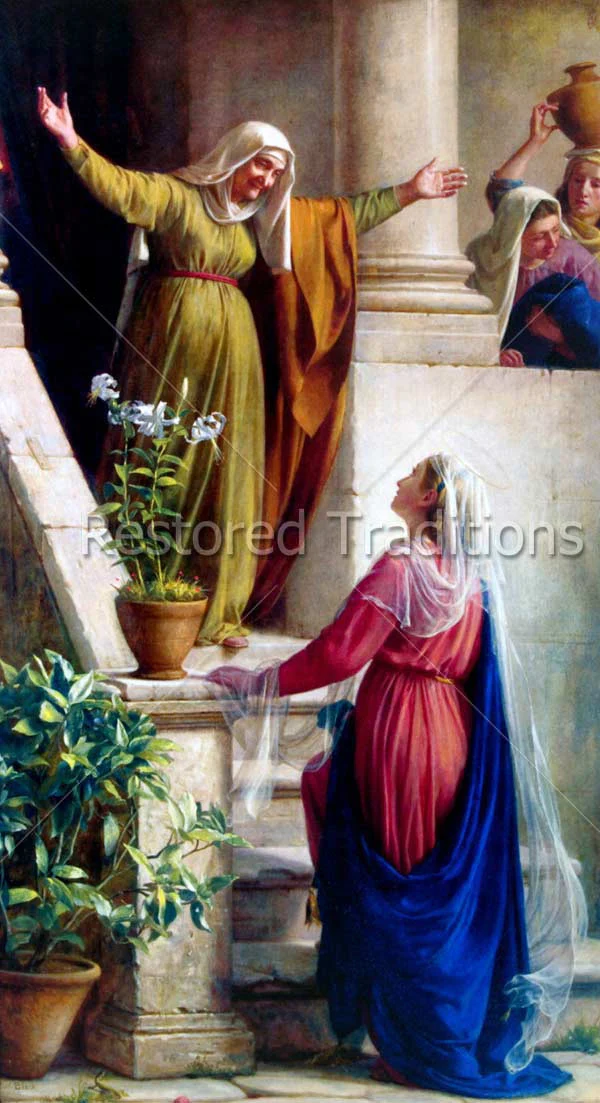
In this beautiful depiction of the Visitation by Carl Bloch, the elderly Elizabeth stands at the top of the steps of her house, with arms joyfully spread wide, welcoming the Blessed Virgin Mary. Our Lady, with a faint halo above her head, looks up at her cousin, listening to the divinely inspired greeting: “Blessed art thou among women and blessed is the fruit of thy womb!” (Lk. 1:42).
Lk 1:39-45
Mary Visits Elizabeth.
39During those days Mary set out and traveled to the hill country in haste to a town of Judah,
40where she entered the house of Zechariah and greeted Elizabeth.
41When Elizabeth heard Mary’s greeting, the infant leaped in her womb, and Elizabeth, filled with the holy Spirit,s
42cried out in a loud voice and said, “Most blessed are you among women, and blessed is the fruit of your womb.t
43And how does this happen to me, that the mother of my Lord* should come to me?
44For at the moment the sound of your greeting reached my ears, the infant in my womb leaped for joy.
45Blessed are you who believed* that what was spoken to you by the Lord would be fulfilled.”u
“Blessed are you among women.”
Elizabeth [was] filled with the holy Spirit” (Luke 1:41). So Luke tells us in his Gospel account of the Visitation. As her cousin Mary greets her, the elderly woman, who is nonetheless great with child, speaks through the power of the Spirit: Elizabeth calls Mary “the mother of my Lord” (Luke 1:43).
For us, it may be routine to hear that Mary is the Mother of God. But Elizabeth would have had no way to know this when Mary appeared on her doorstep. Only the power of God could inform Elizabeth that Mary was carrying the Messiah. Elizabeth stands as a kind of prophet, possessing supernatural knowledge through the influence of the Spirit.
Danish artist Carl Heinrich Bloch, in The Meeting of Mary and Elisabeth(1866), highlighted Elizabeth’s remarkable role. Often, we think of the wife of Zechariah as a minor character. Her son, John the Baptist, is hailed as the last of the great prophets, but it seems his mother also possessed the gift of prophecy. She confirmed what the angel Gabriel told Mary when there was no earthly way to prove the promise was true.
Bloch (1834–1890) puts Elizabeth at the forefront of this scene instead of placing Mary as the focal point. Mary’s back is to us as she gazes upward toward her cousin. Elizabeth’s elevated position and front-facing display make her the center of attention. In beholding this arrangement, the viewer stands with Mary in a kind of awe at the commanding presence of Elizabeth.
Bloch also bathed Elizabeth in light and depicted her upon the heights with arms outstretched in a dramatic gesture that calls to mind the presence of the ancient prophets. One can imagine Moses or Elijah standing upon a mountaintop with such a gesture of confidence and authority. Here Bloch uses the stone steps in place of Mount Sinai, giving Elizabeth her lofty prominence. The Lutheran painter thereby visually assigned tremendous authority to this simple woman of the hill country.
This is a fascinating choice, especially for a painting created to adorn the private King’s Oratory in the castle at Frederiksborg in Denmark. The grand project of the oratory, to which Bloch dedicated 18 years, traced major events from the life of Christ across 23 different panels, including this striking Visitation scene. Did the master painter from the Royal Danish Academy of Art wish to remind the royal family that God often speaks to us through those without power or prestige in the eyes of the world?
Mary, too, has her place in Bloch’s depiction, even if Elizabeth is center stage. The artist bestowed on Mary alone the sign of election and holiness: the halo. Yet in the panel of the Annunciation that hangs directly above the Visitation in the castle chapel, Mary does not yet wear the traditional symbol of sanctity. Only after the Incarnation occurs does Bloch award Mary the halo. His arbitrary distinction between Mary’s holiness prior to the Incarnation and her holiness afterward betrays Bloch’s own religious ideology that would have lacked Catholic confidence in Mary’s immaculate conception.
Bloch does, however, adorn the scene with blooming lilies, a symbol of purity placed deliberately beside the Blessed Virgin, whose hand appears to claim them as her own. Thus, her pregnancy is distinguished from Elizabeth’s, for it was Mary who was both a pure virgin and the Mother of God.
Mary’s profile reveals attentive eyes and a smile that rejoices at the presence of her matronly companion. The words of the Spirit-filled Elizabeth must have offered the young virgin mother tremendous hope and consolation. Mary was not alone — someone else understood and rejoiced alongside her in her most unusual of circumstances.
Saying the holy name of Jesus is the simplest way of praying always.
1-A prayer from Raphael the Archangel:
*While you are on this earth, you must praise the Lord God and give him thanks.
2-A prayer from Tobit and Tobias:
*They began to sing hymns of praise, giving thanks for all the mighty deeds God had done while his angel Raphael had been with them.
3-A simple Jesus prayer:
*Lord, Lord, Jesus Christ…Son of God…have mercy on me…Be kind to others…Work Hard…Be joyful.
4-Another prayer:
*When all that God asks of us is to be quiet and keep ourselves at peace-attentive to the secret work He is beginning in our souls-Be Empty and See That I Am God.
In the time of those kings, the God of heaven will set up a kingdom that will never be destroyed, nor will it be left to another people. It will crush all those kingdoms and bring them to an end, but it will itself endure forever.
Dn 2:44