![CosmicDrama5<span style="color:red;">[NEW]</span>](https://catholicartcollection.com/wp-content/uploads/2025/04/Thumbnail-0008.jpg.webp)





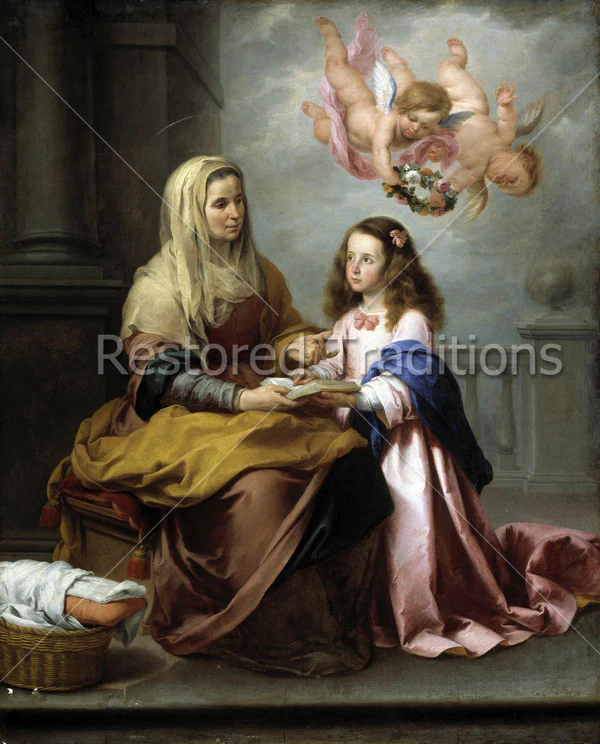
*Sacred Scripture* St. Anne and Our Lady – Murillo
Lives of the Saints
by Alban Butler, Benziger Bros. edition
[1894]
—ST. ANNE.
- ANNE was the spouse of St. Joachim, and was chosen by God to be the mother of Mary, His own blessed Mother on earth. They were both of the royal house of David, and their lives were wholly occupied in prayer and good works. One thing only was wanting to their union.—they were childless, and this was held as a bitter misfortune among the Jews.
At length, when Anne was an aged woman, Mary was born, the fruit rather of grace than of nature, and the child more of God than of man. With the birth of Mary the aged Anne began a new life: she watched her every movement with reverent tenderness, and felt herself hourly sanctified by the presence of her immaculate child.
But she had vowed her daughter to God, to God Mary had consecrated herself again, and to Him Anne gave her back. Mary was three years old when Anne and Joachim led her up the Temple steps, saw her pass by herself into the inner sanctuary, and then saw her no more. Thus was Anne left childless in her lone old age, and deprived of her purest earthly joy just when she needed it most.
She humbly adored the Divine Will, and began again to watch and pray, till God called her to unending rest with the Father and the Spouse of Mary in the home of Mary’s Child.
Reflection.—St. Anne is glorious among the Saints, not only as the mother of Mary, but because she gave Mary to God. Learn from her to reverence a divine vocation as the highest privilege, and to sacrifice every natural tie, however holy, at the call of God.
Saint Anne, the mother of the Blessed Virgin Mary, teaches her young daughter how to read. Cherubs descend from Heaven to place a crown of flowers on Mary’s head. Artwork by E. Murillo.
St. Anne & Young Virgin Mary Picture
Sometimes called “St. Anne Teaching the Child Mary” or “St. Anne Teaching the Virgin to Read” or “The Education of the Virgin,” this image by Bartolomé Esteban Murillo was painted sometime around 1665 and has become one of the most beloved images of St. Anne and Mary. It honors St. Anne, Patron Saint of Grandmothers and Mothers, and helps us see with even more tenderness the childhood of the Blessed Virgin.
The artwork by Bartolome Esteban Murillo features the image of St. Anne and young Mary. An atmosphere of grace and refinement bathes the sweet and pleasant face of Saint Anne and the bright face of Mary. Plump, bright cherubs flutter above the young Mary’s head. The artist lets us sense the young Virgin’s perplexity at the reading of the text of Isaias where it is written: “Behold a virgin shall conceive, and bear a son, and his name shall be called Emmanuel”. Her mother answers her with gentle kindliness that “to God nothing is impossible”.
Charlemagne And The Relics Of Saint Anne
February 1, 2020 Sr. Catherine Goddard Clark
The following will no doubt be taken by some as a Baroque — or worse, Romantic — example of an unenlightened and backward Catholic fascination with legend. So be it. What the critics who generally proffer these skepticisms have given us in exchange for saintly “legend” is so barren that we find ourselves, when reading their banalities, craving “the old time religion” they find so maudlin.
A day will come when it will truly be said of these critics — and for all the world to see — that “They were wrong about evolution, wrong about the inerrancy of Scripture, wrong about Saint Philomena, wrong about the Shroud of Turin, and wrong about just about everything else they pontificated on with such certitude.” Meanwhile, let’s enjoy a healthy dose of well written, supernatural Catholic wonderment, courtesy of Saint Anne and Sister Catherine. — Webmaster (feast of St. Anne: July 26, 2008)
Fourteen years after Our Lord’s death, Saint Mary Magdalen, Saint Martha, Saint Lazarus, and the others of the little band of Christians who were piled into a boat without sails or oars and pushed out to sea to perish — in the persecution of the Christians by the Jews of Jerusalem — were careful to carry with them the tenderly loved body of Our Lady’s mother.
They feared lest it be profaned in the destruction, which Jesus had told them was to come upon Jerusalem. When, by the power of God, their boat survived and finally drifted to the shores of France, the little company of saints buried Saint Anne’s body in a cave, in a place called Apt, in the south of France. The church, which was later built over the spot, fell into decay because of wars and religious persecutions, and as the centuries passed, the place of Saint Anne’s tomb was forgotten.
The long years of peace, which Charlemagne’s wise rule gave to southern France, enabled the people to build a magnificent new church on the site of the old chapel at Apt. Extraordinary and painstaking labor went into the building of the great structure, and when the day of its consecration arrived [Easter Sunday, 792 A.D.], the beloved Charlemagne, little suspecting what was in store for him, declared himself happy indeed to have journeyed so many miles to be present for the holy occasion. At the most solemn part of the ceremonies, a boy of fourteen, blind, deaf and dumb from birth — and usually quiet and impassive — to the amazement of those who knew him, completely distracted the attention of the entire congregation by becoming suddenly tremendously excited. He rose from his seat, walked up the aisle to the altar steps, and to the consternation of the whole church, struck his stick resoundingly again and again upon a single step.
His embarrassed family tried to lead him out, but he would not budge. He continued frantically to pound the step, straining with his poor muted senses to impart a knowledge sealed hopelessly within him. The eyes of the people turned upon the emperor, and he, apparently inspired by God, took the matter into his own hands. He called for workmen to remove the steps.
A subterranean passage was revealed directly below the spot, which the boy’s stick had indicated. Into this passage the blind lad jumped, to be followed by the emperor, the priests, and the workmen.
They made their way in the dim light of candles, and when, farther along the passage, they came upon a wall that blocked further advance, the boy signed that this also should be removed. When the wall fell, there was brought to view still another long, dark corridor. At the end of this, the searchers found a crypt, upon which, to their profound wonderment, a vigil lamp, alight and burning in a little walled recess, cast a heavenly radiance.
As Charlemagne and his afflicted small guide, with their companions, stood before the lamp, its light went out. And at the same moment, the boy, blind and deaf and dumb from birth, felt sight and hearing and speech flood into his young eyes, his ears, and his tongue.
“It is she! It is she!” he cried out. The great emperor, not knowing what he meant, nevertheless repeated the words after him. The call was taken up by the crowds in the church above, as the people sank to their knees, bowed in the realization of the presence of something celestial and holy.
The crypt at last was opened, and a casket was found within it. In the casket was a winding sheet, and in the sheet were relics, and upon the relics was an inscription that read, “Here lies the body of Saint Anne, mother of the glorious Virgin Mary.” The winding sheet, it was noted, was of eastern design and texture.
Charlemagne, overwhelmed, venerated with profound gratitude the relics of the mother of Heaven’s Queen. He remained a long time in prayer. The priests and the people, awed by the graces given them in such abundance and by the choice of their countryside for such a heavenly manifestation, for three days spoke but rarely, and then in whispers.
The emperor had an exact and detailed account of the miraculous finding drawn up by a notary and sent to Pope Saint Leo III, with an accompanying letter from himself. These documents and the pope’s reply are preserved to this day. Many papal bulls have attested, over and over again, to the genuineness of Saint Anne’s relics at Apt.
Countless cures and conversions have taken place at the shrine there, where the greater part of the relics still repose: the first shrine in the West to the tenderly understanding and most powerful saint whose august and unutterable privilege it was to be the mother of the Mother of God and the instrument of the Immaculate Conception.
Sister Catherine Goddard Clark was the foundress of the original Saint Benedict Center in Cambridge, Massachusetts, and also one of the founding members of the Slaves of the Immaculate Heart of Mary. She was the author of several books.
The image shows Saint Anne with the Virgin Mary as a Child, painted by Bartolome Esteban Murillo, ca. 17th-century.
Saying the holy name of Jesus is the simplest way of praying always.
1-A prayer from Raphael the Archangel:
*While you are on this earth, you must praise the Lord God and give him thanks.
2-A prayer from Tobit and Tobias:
*They began to sing hymns of praise, giving thanks for all the mighty deeds God had done while his angel Raphael had been with them.
3-A simple Jesus prayer:
*Lord, Lord, Jesus Christ…Son of God…have mercy on me…Be kind to others…Work Hard…Be joyful.
4-Another prayer:
*When all that God asks of us is to be quiet and keep ourselves at peace-attentive to the secret work He is beginning in our souls-Be Empty and See That I Am God.
“The days are coming,” declares the Lord, “when I will fulfill the good promise I made to the people of Israel and Judah.”
Jer 33:14