![CosmicDrama5<span style="color:red;">[NEW]</span>](https://catholicartcollection.com/wp-content/uploads/2025/04/Thumbnail-0008.jpg.webp)





The Nativity of the Lord – Christmas
Lives of the Saints
by Alban Butler, Benziger Bros. edition
[1894]
December 25.—THE NATIVITY OF CHRIST, OR CHRISTMAS DAY.
The world had subsisted about four thousand years when Jesus Christ, the eternal Son of God, having taken human flesh in the womb of the Virgin Mary, and being made man, was born of her, for the redemption of mankind, at Bethlehem of Judea.
Joseph and Mary had come up to Bethlehem to be enrolled, and, unable to find shelter elsewhere, they took refuge in a stable, and in this lowly place Jesus Christ was born. The Blessed Virgin wrapped the divine Infant in swaddling-clothes, and laid Him in the manger.
While the sensual and the proud were asleep, an angel appeared to some poor shepherds. They were seized with great fear, but the heavenly messenger said to them: “Fear not: for behold I bring you good tidings of exceeding great joy, that shall be to all the people. For this day is born to you a Savior, Who is Christ the Lord, in the city of David. And this shall be a sign to you: you shall find the Child wrapped in swaddling-clothes, and laid in a manger.”
After the departure of the angel the wondering shepherds said to one another: “Let us go over to Bethlehem, and let us see the word that is come to pass, which the Lord hath shown to us.” They immediately hastened thither, and found Mary and Joseph, and the Infant lying in the manger. Bowing down they adored Him, and then returned to their flocks, glorifying and praising God.
Reflection.—Our Savior sanctified our flesh by taking it on Himself, and with His last breath He commended us to the care of His Virgin Mother. Day by day He still feeds us at the altar with the food of incorruption—His body and His blood.
The Nativity of the Lord – Christmas Solemnity Vigil: Is 62:1-5/Acts 13:16-17, 22-25/Mt 1:1-25 or 1:18-25 (13) Night: Is 9:1-6/Ti 2:11-14/Lk 2:1-14 (14) Dawn: Is 62:11-12/Ti 3:4-7/Lk 2:15-20 (15) Day: Is 52:7-10/Heb 1:1-6/Jn 1:1-18 or 1:1-5, 9-14 (16) Pss Prop.
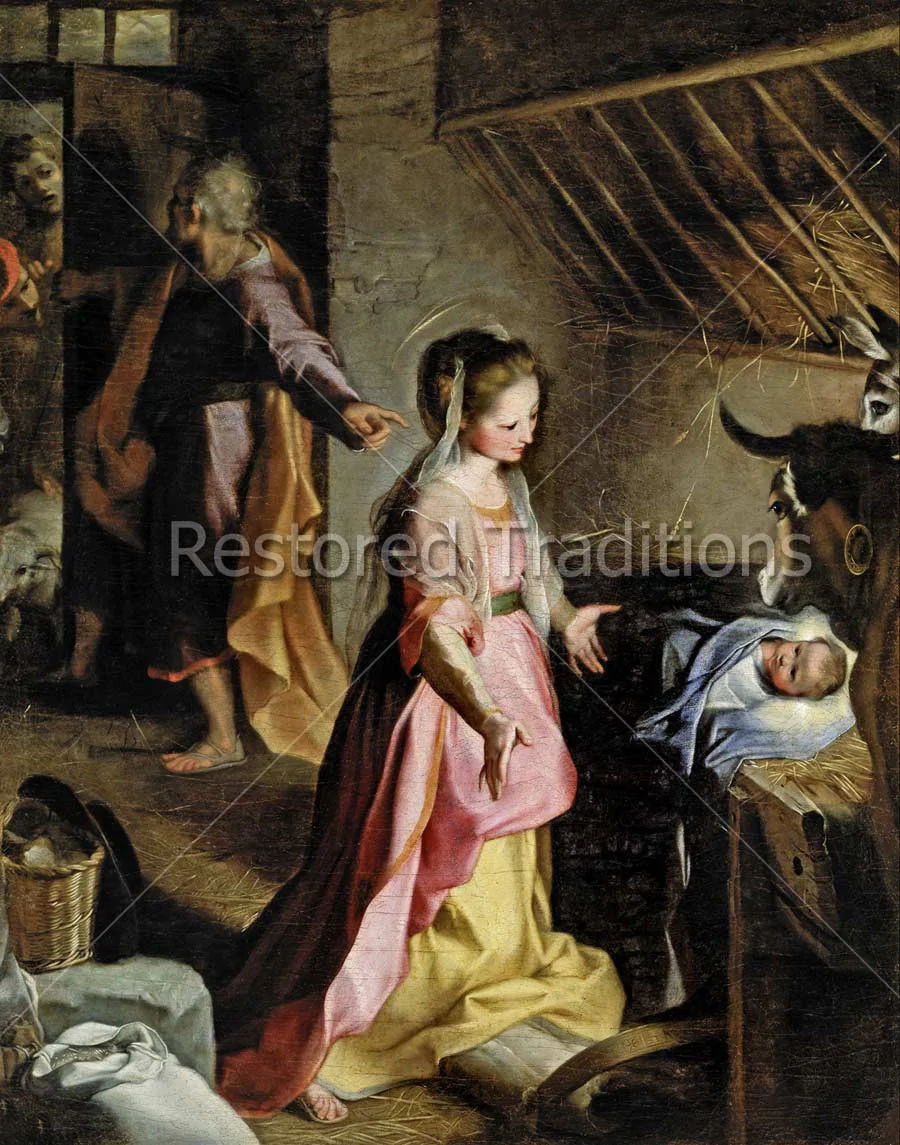
*The Nativity – Barocci.
The Blessed Virgin Mary lovingly kneels beside Our Lord lying in a manger, while Saint Joseph opens the stable door for shepherds. Artwork by F. Barocci.
**Birth of Jesus-A nativity scene takes its inspiration from the accounts of the birth of Jesus in the Gospels of Matthew and Luke. Luke’s narrative describes an angel announcing the birth of Jesus to shepherds who then visit the humble site where Jesus is found lying in a manger, a trough for cattle feed.(Luke 2:8-20) Matthew’s narrative tells of “wise men” (Greek: μαγοι, romanized: magoi ) who follow a star to the house where Jesus dwelt, and indicates that the Magi found Jesus some time later, less than two years after his birth, rather than on the exact day (Mat. 2:1–23). Matthew’s account does not mention the angels and shepherds, while Luke’s narrative is silent on the Magi and the star. The Magi and the angels are often displayed in a nativity scene with the Holy Family and the shepherds (Luke 2:7, 12, 17).
https://en.wikipedia.org/wiki/Nativity_of_Jesus
***The nativity is the basis for the Christian holiday of Christmas and plays a major role in the Christian liturgical year. Many Christians traditionally display small manger scenes depicting the nativity in their homes, or attend nativity plays or Christmas pageants focusing on the nativity cycle in the Bible. Elaborate nativity displays called “creche scenes”, featuring life-sized statues, are a tradition in many continental European countries during the Christmas season. The artistic depiction of the nativity has been an important subject for Christian artists since the 4th century. Artistic depictions of the nativity scene since the 13th century have emphasized the humility of Jesus and promoted a more tender image of him, a major change from the early “Lord and Master” image, mirroring changes in the common approaches taken by Christian pastoral ministry during the same era.
****Saint Francis of Assisi, who is now commemorated on the calendars of the Catholic, Lutheran and Anglican liturgical calendars, is credited with creating the first live nativity scene in 1223 at Greccio, central Italy, in an attempt to place the emphasis of Christmas upon the worship of Christ rather than upon “material things”. The nativity scene created by Saint Francis, is described by Saint Bonaventure in his Life of Saint Francis of Assisi written around 1260. Staged in a cave near Greccio, Saint Francis’ nativity scene was a living one with humans and animals cast in the Biblical roles. Pope Honorius III gave his blessing to the exhibit.
https://en.wikipedia.org/wiki/Nativity_scene
For to us a child is born, to us a son is given, and the government will be on his shoulders. And he will be called Wonderful Counselor, Mighty God, Everlasting Father, Prince of Peace.
Is 9:6