![CosmicDrama5<span style="color:red;">[NEW]</span>](https://catholicartcollection.com/wp-content/uploads/2025/04/Thumbnail-0008.jpg.webp)





*Sacred Scripture* Divine Inspiration of Music – Regnier
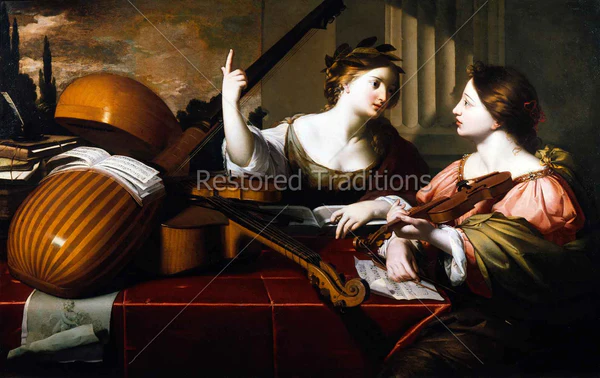
Two women play musical instruments together and speak of Heaven, in this artwork by N. Regnier.
*On the third level of the Ahmanson Building is Divine Inspiration of Music, a 1640 painting by Nicolas Regnier, a Flemish artist who worked in Baroque Rome in the style of Caravaggio, whose agent was also Regnier’s agent. Many of his genre paintings that were created while the artist was in Rome were of the same subjects imbued with the melodramatic chiaroscuro so typical of Caravaggio’s art. In 1625, Regnier would move to Venice. Gone was the artful gloom of Rome, and those once-shadowy figures were to become bright and decorative with a lyrical frisson.
Venice then was known as the “Republic of Music,” and, as reported by a tourist, “in every home someone is playing a musical instrument or singing.” Operas were the dominant form, lush and fantastic, an occasion of wonder. The giant was Claudio Monteverdi, whose opera The Coronation of Poppea thrills audiences even today, and there was also Francesco Cavalli and Benedetto Ferrari. Here the instrumental ensemble would come alive and be celebrated.
The ensemble in Regnier’s exquisite brush casts the details of his Divine Inspiration of Music, with its two ladies and sheets of music, two violins, viola, long-neck lute known as a theorbo, and possibly a half-hidden chitarra italiana, a sort of mandolin. Regnier beautifully renders these instruments to such a degree that he captures the dynamic vigor of this almost-lost world of music.
**After starting his career in Rome and emulating the chiaroscuro style of Caravaggio, Nicolas Regnier moved to Venice in 1625 and completely changed his style to one of light and brilliancy. Venice in the 17th century was known as the ‘Republic of Music,’ and visitors reported that every household made music. Opera was the new musical form of the day and the instrumental ensemble found its new place. In this ensemble, two women, one crowned with a laurel wreath, is among a feast of stringed instruments. There are two violins, a viola da gamba, a theorbo (a long-necked lute), and another instrument of which we can only see the back. The woman on the right has just put down her bow while the woman on the left points to heaven, the source of all musical inspiration. Music books are scattered around the table along with a rolled-up picture of a small child holding an instrument that might be a lyre.
Keep me safe, my God, for in you I take refuge. I say to the Lord, “You are my Lord; apart from you I have no good thing.”
Ps 16:1–2