![CosmicDrama5<span style="color:red;">[NEW]</span>](https://catholicartcollection.com/wp-content/uploads/2025/04/Thumbnail-0008.jpg.webp)





*Sacred Scripture* Tower of Babel – Bruegel
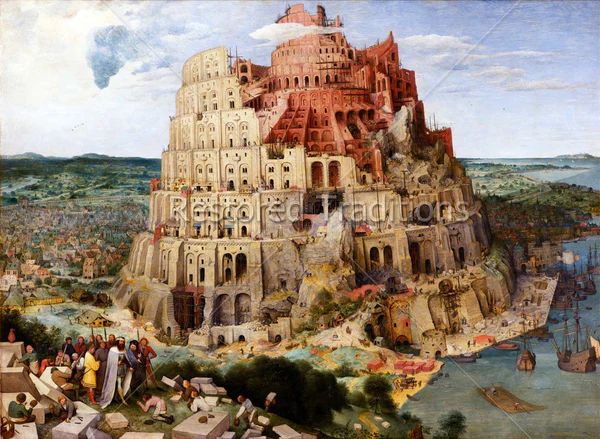
A fantastical depiction of the construction of the Tower of Babel, by artist P. Bruegel.
Gn 11:1-9
Tower of Babel.*
1The whole world had the same language and the same words.
2When they were migrating from the east, they came to a valley in the land of Shinar* and settled there.
3They said to one another, “Come, let us mold bricks and harden them with fire.” They used bricks for stone, and bitumen for mortar.
4Then they said, “Come, let us build ourselves a city and a tower with its top in the sky,* and so make a name for ourselves; otherwise we shall be scattered all over the earth.”
5The LORD came down to see the city and the tower that the people had built.
6Then the LORD said: If now, while they are one people and all have the same language, they have started to do this, nothing they presume to do will be out of their reach.
7Come, let us go down and there confuse their language, so that no one will understand the speech of another.
8So the LORD scattered them from there over all the earth, and they stopped building the city.
9That is why it was called Babel,* because there the LORD confused the speech of all the world. From there the LORD scattered them over all the earth.
https://bible.usccb.org/bible/genesis/11
Interpretation of Tower of Babel-By Pieter Bruegel the Elder
One of a number of panel paintings devoted to religious art, this picture (commissioned by the Antwerp art collector Niclaes Jonghelinck and now in the Kunsthistorisches Museum, Vienna) was the second of three versions of the biblical Tower of Babel, painted by Pieter Bruegel. The first version (now lost), was an ivory miniature, which was listed in the inventory of the Croatian-born Italian miniaturist Giulio Clovio (1498-1578), with whom Bruegel collaborated in Rome in 1553. The third version was a smaller oil painting on wood, dated 1564, which is now in the Museum Boijmans Van Beuningen in Rotterdam. The Rotterdam painting is generally thought to date from a year or so after the picture in Vienna. The Viennese “Big” Tower, is almost twice as large as the Rotterdam “Little” Tower and is characterized by a more traditional treatment of the subject. Based on Genesis 11: 1-9, in which the Lord confounds the people who began to build “a tower whose top may reach unto Heaven”, it includes – as the other version does not – the scene of King Nimrod and his retinue appearing before the genuflecting crowd of workmen. This event is not mentioned in the Bible but was suggested in Flavius Josephus’ Antiquities of the Jews. It was important to Bruegel as underlining the sin of the King’s pride and overbearing which the picture is supposed to highlight. Like Saul, in The Suicide of Saul (1562, Kunsthistorisches Museum, Vienna), Nimrod too is punished for his pride. Both men were given similar treatment by Dante in his Purgatory (where the scene is represented in carving XII, 40-42), by Sebastian Brant in his Ship of Fools. Curiously, despite this, the Rotterdam version is the one most often copied – see for instance, Tower of Babel (1568) by Lucas van Valckenborgh (1535-97), now in the Alte Pinakothek, Munich. Both the Old Testament theme of Bruegel’s painting, and its low-key composition, are in line with the new aesthetic guidelines of Protestant Reformation art of the 16th century.
Roman Colosseum: A Symbol of Human Hubris
The rendering of the tower as a huge structure with spiraling ramps was relatively common in Northern Renaissance art such as book illumination. But the inspiration for other aspects of Bruegel’s extraordinary architecture came from the Colosseum in Rome, perhaps by way of early reminiscences and sketches, or the series of prints made by Bruegel’s main publisher, Hieronymus Cock. The Roman Colosseum was regarded at the time as a symbol of hubris and of persecution. Or, to put it another way, Rome was the Eternal City, built by the Caesars to last for ever. Its subsequent decay and collapse was understood by Protestants to symbolize the vanity and transience of Man’s earthly ambitions and efforts.
The Tower is Babylonian in meaning, but Roman in design. His most important forerunner in this respect was Simon Bening – the painter of the miniature of the Babylonian Tower in the Grimani Breviary – who populated the ramps and the environment of the Tower with untold multitudes of workmen and building utensils, and showed Nimrod in a similiarly commanding and slave-driving role. However, the Tower of the Grimani Breviary has a square shape and looks much less Roman than does Bruegel’s. Paradoxically, judging by the noticeable instability of Bruegel’s structure, the painting seems to indicate that the ultimate failure of the Tower was due to engineering difficulties instead of God’s decision to strip the people of their common tongue.
Bruegel has placed the Tower in a coastal landscape, near a river, perhaps reflecting the fact that waterways, rather than unpaved country roads, carried most of the heavy goods during the 16th century. The subject and its site was also intended to mirror the situation in Antwerp, where rapid building growth had caused widespread problems. The painting thus served as an allegorical warning for the city’s authorities, similar to that of Mad Meg (Dulle Griet) (c.1562, Museum Mayer van den Bergh, Antwerp).
The Futility of Human Ambitions and Efforts
The detailed illustration of the frenzied efforts of the engineers, masons and labourers suggests a second moral – the pointlessness of human endeavour, a theme also touched on by Sebastian Brant in his Ship of Fools. Bruegel returned to this theme in several different works: in Hunters in the Snow (1565, Kunsthistorisches Museum, Vienna) for instance, he conveys the idea that man is a powerless entity, of no consequence, who is at the mercy of the natural seasons and rhythms of the year.
Detailed Realism
The Tower of Babel features a host of meticulous details, relating to the construction of the building – enhanced, no doubt, by Bruegel’s intricate knowledge of building techniques, acquired during his execution of several paintings illustrating the digging of the Antwerp-Brussels canal. To the right is a huge crane, very similar to the one placed conspiciously above the harbour in the Grimani Breviary. The ant-like labourers are busy loading it with huge stone slabs which they have received from below and will pass onto the the higher ramp where others are prepared to receive them. One workman climbs a ladder toward that section, which is being transformed from rock into structured architecture by a host of other people. On the left, part of the facade is already being completed in part; a woman enters one of the gates, a ladder sticks out of one of the upper windows, farther up another large crowd of labourers works on the roof – and so on ad infinitum.
Whatever the reasonableness of these individual actions may be – and this point has not yet been fully investigated – one immediately senses the grotesque inadequacy of means as well as the folly of the entire enterprise. However industrious these ‘ants’ may be, they are up against hopeless odds which are brilliantly demonstrated. Within the same level completion of the last detail stands against bare beginnings, with intermediary stages in between, thus intimating a frantic race against inexorable time, while the upper part is still invaded by clouds.
Movement
While Bruegel took enormous pleasure in rendering every detail with an almost scientific exactness, he was also intensely curious about the subject of movement. The Rotterdam Tower of Babel, for instance, seems to be experiencing some form of unsteady rotation. Bruegel’s fascination with movement led him to explore the falling figure, a pictorial concept which finds its ultimate expression in The Parable of the Blind (1568).
Bruegel’s Oeuvre
One of the most versatile figures in Flemish painting, Bruegel’s pictures cover a wide range of subjects. As well as landscape painting, his religious paintings feature a number of conventional Biblical scenes (Massacre of the Innocents, Procession to Calvary) including parables of Christ (Parable of the Blind), as well as mythological subjects (Landscape with the Fall of Icarus) and proverbial sayings (Netherlands Proverbs). His allegorical pictures are typically of a religious character, see for instance the two sets of engravings – The Vices (1556-57) and The Virtues (1559-60), although they also include social satires. His ‘peasant’ genre painting – exemplified by The Wedding Dance (1566), The Land of Cockaigne (1567), The Peasant Wedding (1568) and The Peasant Dance (1568) – are also well known, as are less straightforward works such as The Fight Between Carnival and Lent (1559), Children’s Games (1560), and Mad Meg (Dulle Griet) (1562).
Saying the holy name of Jesus is the simplest way of praying always.
1-A prayer from Raphael the Archangel:
*While you are on this earth, you must praise the Lord God and give him thanks.
2-A prayer from Tobit and Tobias:
*They began to sing hymns of praise, giving thanks for all the mighty deeds God had done while his angel Raphael had been with them.
3-A simple Jesus prayer:
*Lord, Lord, Jesus Christ…Son of God…have mercy on me…Be kind to others…Work Hard…Be joyful.
4-Another prayer:
*When all that God asks of us is to be quiet and keep ourselves at peace-attentive to the secret work He is beginning in our souls-Be Empty and See That I Am God.
I will praise you, Lord, with all my heart; before the “gods” I will sing your praise. I will bow down toward your holy temple and will praise your name for your unfailing love and your faithfulness, for you have so exalted your solemn decree that it surpasses your fame.
Ps 138:1–2