![CosmicDrama5<span style="color:red;">[NEW]</span>](https://catholicartcollection.com/wp-content/uploads/2025/04/Thumbnail-0008.jpg.webp)





Saint Margaret of Scotland & Saint Gertrude
Lives of the Saints
by Alban Butler, Benziger Bros. edition
[1894]
June 10.—ST. MARGARET OF SCOTLAND.
- MARGARET’S name signifies “pearl;” “a fitting name,” says Theodoric, her confessor and her first biographer, “for one such as she.” Her soul was like a precious pearl. A life spent amidst the luxury of a royal court never dimmed its lustre, or stole it away from Him who had bought it with His blood. She was the grand, daughter of an English king; and in 1070 she became the bride of Malcolm, and reigned Queen of Scotland till her death in 1093. How did she become a Saint in a position where sanctity is so difficult? First, she burned with zeal for the house of God. She built churches and monasteries; she busied herself in making vestments; she could not rest till she saw the laws of God and His Church observed throughout her realm. Next, amidst a thousand cares, she found time to converse with God—ordering her piety with such sweetness and discretion that she won her husband to sanctity like her own. He used to rise with her at night for prayer; he loved to kiss the holy books she used, and sometimes he would steal them away, and bring them back to his wife covered with jewels. Lastly, with virtues so great, she wept constantly over her sins, and begged her confessor to correct her faults. St. Margaret did not neglect her duties in the world because she was not of it. Never was a better mother. She spared no pains in the education of her eight children, and their sanctity was the fruit of her prudence and her zeal. Never was a better queen. She was the most trusted counsellor of her husband, and she labored for the material improvement of the country. But, in the midst of the world’s pleasures, she sighed for the better country, and accepted death as a release. On her death-bed she received the news that her husband and her eldest son were slain in battle. She thanked God, Who had sent this last affliction as a penance for her sins. After receiving Holy Viaticum, she was repeating the prayer from the Missal, “O Lord Jesus Christ, Who by Thy death didst give life to the world, deliver me.” At the words “deliver me,” says her biographer, she took her departure to Christ, the Author of true liberty.
Reflection.—All perfection consists in keeping a guard upon the heart. Wherever we are, we can make a solitude in our hearts, detach ourselves from the world, and converse familiarly with God. Let us take St. Margaret for our example and encouragement.
Saint Margaret of Scotland; Saint Gertrude, Virgin Rv 4:1-11/Lk 19:11-28 (499).
https://www.ewtn.com/catholicism/saints/margaret-of-scotland-682
CATHOLICISM SAINTS ST. MARGARET OF SCOTLAND
https://www.ewtn.com/catholicism/saints/gertrude-the-great-587
CATHOLICISM SAINTS ST. GERTRUDE THE GREAT
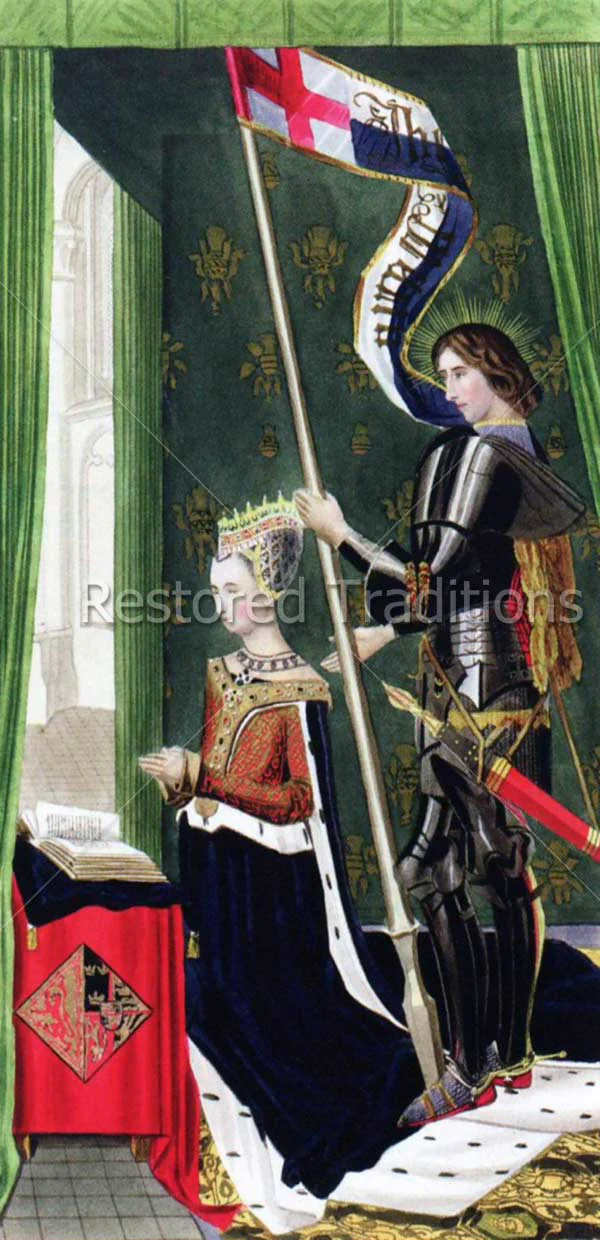
*St. Margaret of Scotland – Shaw.
Saint Margaret, Queen of Scotland, also known as “Margaret of Wessex”, was called “The Pearl of Scotland”. Artwork by H. Shaw.
**Saint Margaret of Scotland (Scottish Gaelic: Naomh Maighréad; Scots: Saunt Marget, c. 1045 – 16 November 1093), also known as Margaret of Wessex, was an English princess and a Scottish queen. Margaret was sometimes called “The Pearl of Scotland”. Born in the Kingdom of Hungary to the expatriate English prince Edward the Exile, Margaret and her family returned to England in 1057. Following the death of king Harold II at the Battle of Hastings in 1066, her brother Edgar Ætheling was elected as King of England but never crowned. After she and her family fled north, Margaret married Malcolm III of Scotland by the end of 1070.
https://en.wikipedia.org/wiki/Saint_Margaret_of_Scotland
Lives of the Saints
by Alban Butler, Benziger Bros. edition
[1894]
November 15.—ST. GERTRUDE, Abbess.
GERTRUDE was born in the year 1263, of a noble Saxon family, and placed at the age of five for education in the Benedictine abbey of Rodelsdorf. Her strong mind was carefully cultivated, and she wrote Latin with unusual elegance and force; above all, she was perfect in humility and mortification, in obedience, and in all monastic observances. Her life was crowded with wonders. She has in obedience recorded some of her visions, in which she traces in words of indescribable beauty the intimate converse of her soul with Jesus and Mary. She was gentle to all, most gentle to sinners; filled with devotion to the Saints of God, to the souls in purgatory, and above all to the Passion of Our Lord and to His Sacred Heart. She ruled her abbey with perfect wisdom and love for forty years. Her life was one of great and almost continual suffering, and her longing to be with Jesus was not granted till 1334, when she had reached her seventy-second year.
Reflection.—No preparation for death can be better than to offer and resign ourselves anew to the Divine Will—humbly, lovingly, with unbounded confidence in the infinite mercy and goodness of God.
***Gertrude the Great (or Saint Gertrude of Helfta; Italian: Santa Gertrude, German: Gertrud die Große von Helfta, Latin: Sancta Gertrudis; January 6, 1256 – November 17, 1302) was a German Benedictine nun and mystic. She is recognized as a saint by the Catholic Church and by The Episcopal Church. In addition to being commemorated in the Episcopal Calendar of Saints on November 21, Gertrude is inscribed in the General Roman Calendar for optional celebration throughout the Roman Rite, as a memorial on November 16.
https://en.wikipedia.org/wiki/Gertrude_the_Great
Now faith is confidence in what we hope for and assurance about what we do not see.
Heb 11:1