
- This event has passed.
Solemnity of Mary, The Holy Mother of God
Solemnity of Mary, The Holy Mother of God – Solemnity The Octave Day of the Nativity of the Lord Nm 6:22-27/Gal 4:4-7/Lk 2:16-21 (18) Pss Prop.
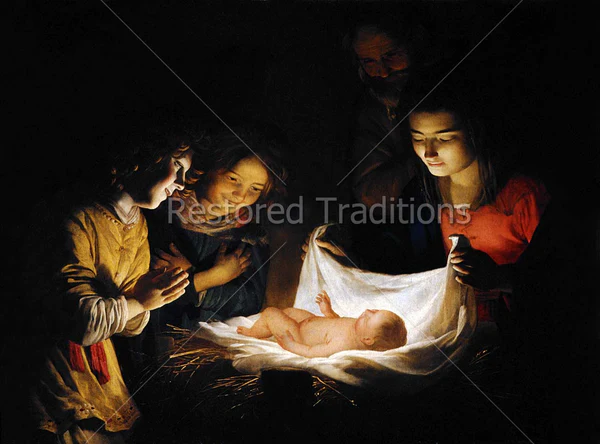
*Adoration of the Child – Honthorst.
This Nativity artwork, by Honthorst, shows shepherds adoring the Christ Child after His birth in the stable. The Virgin Mary kneels on the right, while St. Joseph stands in the back. Two young shepherds kneel on the left. All gaze down, smiling, at the newborn Christ.
**Various paintings-Adoration of the Shepherds.
https://restoredtraditions.com/search?type=product&q=shepherds
**The octave of Christmas is celebrated as an eight-day feast which begins on the Nativity, Dec. 25, and continues to January 1, the Solemnity of Mary, the Mother of God. Since at least the fourth century, Christians have celebrated the most important liturgical feasts with “octaves” — eight days of celebration.
Luke 2:16-21 – So they hurried off and found Mary and Joseph, and the baby, who was lying in the manger. 17 When they had seen him, they spread the word concerning what had been told them about this child, 18 and all who heard it were amazed at what the shepherds said to them. 19 But Mary treasured up all these things and pondered them in her heart. 20 The shepherds returned, glorifying and praising God for all the things they had heard and seen, which were just as they had been told.
***From Christmas Day until January 1st, the Solemnity of the Blessed Virgin Mary, the Mother of God, is the Octave Day of Christmas. The Liturgy gives the clues that every day within the octave is treated the same as the original feast day of the Nativity of our Lord. The Liturgy of the Hours repeats Sunday Week I every day of the octave. The Mass has a special Communicantes (In communion…) to insert every day of the Octave when Eucharistic Prayer I is used:
Celebrating the most sacred night (day)
on which blessed Mary the immaculate Virgin
brought forth the Savior for this world,
and in communion with those whose memory we venerate,
especially the glorious ever-Virgin Mary,
Mother of our God and Lord, Jesus Christ…
Finally, the Gloria is repeated each day of the Octave.
Despite having four days within the octave that are feasts: St. Stephen, St. John the Evangelist, the Holy Innocents and the Holy Family, each of these days is another “day of the octave of Christmas.”
The main difference between the Easter Octave and the Christmas Octave is that every day in Easter is another solemnity, and Christmas only has two solemnities, December 25, Christmas and January 1, Mary Mother of God. The days in-between are varying levels of feast days.
****Today’s reading is a continuation from the Gospel proclaimed at the Christmas Mass at midnight. In it the shepherds act upon the message they receive from the angel and go to find Jesus in the manger in Bethlehem. In their visit to the manger, the shepherds find things just as the angel had said. The shepherds’ visit, therefore, is a moment of fulfillment, manifestation, and the beginning of the salvation we receive through Christ. In the context of today’s Solemnity, this reading also helps us focus on Mary as the Mother of God. The reading tells us at least three things about Mary as a mother. First, Mary is described as a reflective person, keeping the reports of the shepherds in her heart. Second, we are reminded of how obedient Mary was to God when she named the baby Jesus as the angel Gabriel had directed. Third, this reading shows Mary and Joseph faithfully observing their Jewish tradition by having Jesus circumcised.
This, then, is how you should pray: “Our Father in heaven, hallowed be your name, your kingdom come, your will be done, on earth as it is in heaven.”
Mt 6:9–10