
- This event has passed.
The Epiphany of the Lord
Lives of the Saints
by Alban Butler, Benziger Bros. edition
[1894]
—THE EPIPHANY OF OUR LORD.
THE word Epiphany means “manifestation,” and it has passed into general acceptance throughout the universal Church, from the fact that Jesus Christ manifested to the eyes of men His divine mission on this day first of all, when a miraculous star revealed His birth to the kings of the East, who, in spite of the difficulties and dangers of a long and tedious journey through deserts and mountains almost impassable, hastened at once to Bethlehem to adore Him and to offer Him mystical presents, as to the Ding of kings, to the God of heaven and earth, and to a Man withal feeble and mortal.
The second manifestation was when, going out from the waters of the Jordan after having received Baptism from the hands of St. John, the Holy Ghost descended on Him in the visible form of a dove, and a voice from heaven was heard, saying, “This is My beloved Son, in Whom I am well pleased.”
The third manifestation was that of His divine power, when at the marriage-feast of Cana He changed the water into wine, at the sight whereof His disciples believed in Him.
The remembrance of these three great events, concurring to the same end, the Church has wished to celebrate in one and the same festival.
Reflection.—Admire the almighty power of this little Child, Who from His cradle makes known His coming to the shepherds and magi—to the shepherds by means of His angel, to the magi by a star in the East. Admire the docility of these kings. Jesus is born; behold them at His feet? Let us be little, let us hide ourselves, and the divine strength will be granted to us. Let us be docile and quick in following divine inspirations, and we shall then become wise of the wisdom of God, powerful in His almighty power.
The Epiphany of the Lord Solemnity Is 60:1-6/Eph 3:2-3a, 5-6/Mt 2:1-12 (20) Pss Prop.
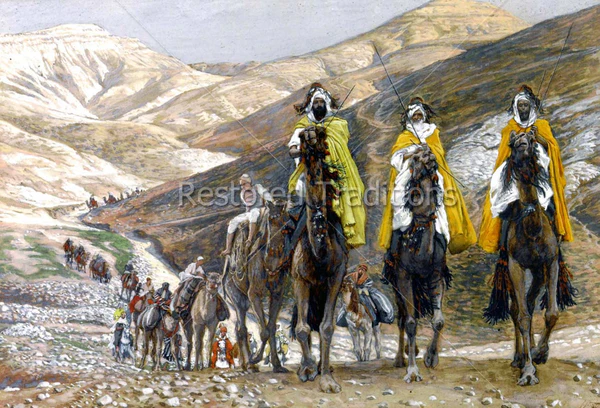
*Journey of the Magi – Tissot.
This lovely watercolor by J. Tissot shows the Three Kings travelling on camels, accompanied by a caravan, in search of the Christ Child.
**The biblical Magi (/ˈmeɪdʒaɪ/ or /ˈmædʒaɪ/; singular: magus), also referred to as the (Three) Wise Men or (Three) Kings, also the Three Magi were distinguished foreigners in the Gospel of Matthew and Christian tradition. They are said to have visited Jesus after his birth, bearing gifts of gold, frankincense and myrrh. They are regular figures in traditional accounts of the nativity celebrations of Christmas and are an important part of Christian tradition. The Gospel of Matthew is the only one of the four canonical gospels to mention the Magi. Matthew 2:1-2 has it that they came “from the east” to worship the “king of the Jews.” The gospel never mentions the number of Magi. Still, most western Christian denominations have traditionally assumed them to have been three in number, based on the statement that they brought three gifts. In Eastern Christianity, especially the Syriac churches, the Magi often number twelve. Their identification as kings in later Christian writings is probably linked to Isaiah 60:1–6, which refers to “kings [coming] to the brightness of your dawn” bearing “gold and frankincense.” Further identification of the magi with kings may be due to Psalm 72:11, “May all kings fall down before him.”
https://en.wikipedia.org/wiki/Biblical_Magi
***Matthew 2:1-12
The Magi Visit the Messiah
2 After Jesus was born in Bethlehem in Judea, during the time of King Herod, Magi[a] from the east came to Jerusalem 2 and asked, “Where is the one who has been born king of the Jews? We saw his star when it rose and have come to worship him.”
3 When King Herod heard this he was disturbed, and all Jerusalem with him. 4 When he had called together all the people’s chief priests and teachers of the law, he asked them where the Messiah was to be born. 5 “In Bethlehem in Judea,” they replied, “for this is what the prophet has written:
6 “‘But you, Bethlehem, in the land of Judah,
are by no means least among the rulers of Judah;
for out of you will come a ruler
who will shepherd my people Israel.’[b]”
7 Then Herod called the Magi secretly and found out from them the exact time the star had appeared. 8 He sent them to Bethlehem and said, “Go and search carefully for the child. As soon as you find him, report to me, so that I too may go and worship him.”
9 After they had heard the king, they went on their way, and the star they had seen when it rose went ahead of them until it stopped over the place where the child was. 10 When they saw the star, they were overjoyed. 11 On coming to the house, they saw the child with his mother Mary, and they bowed down and worshiped him. Then they opened their treasures and presented him with gifts of gold, frankincense and myrrh. 12 And having been warned in a dream not to go back to Herod, they returned to their country by another route.