
The Transfiguration of the Lord
Lives of the Saints
by Alban Butler, Benziger Bros. edition
[1894]
August 6.—THE TRANSFIGURATION OF OUR LORD.
OUR divine Redeemer, being in Galilee about a year before His sacred Passion, took with Him St. Peter and the two sons of Zebedee, Sts. James and John, and led them to a retired mountain.
Tradition assures us that this was Mount Thabor, which is exceedingly high and beautiful, and was anciently covered with green trees and shrubs, and was very fruitful.
It rises something like a sugar-loaf, in a vast plain in the middle of Galilee. This was the place in which the Man-God appeared in His glory. Whilst Jesus prayed, He suffered that glory which was always due to His sacred humility, and of which, for our sake, He deprived it, to diffuse a ray over His whole body. His face was altered and shone as the sun, and His garments became white as snow. Moses and Elias were seen by the three apostles in His company on this occasion and were heard discoursing with Him of the death which He was to suffer in Jerusalem.
The three apostles were wonderfully delighted with this glorious vision, and St. Peter cried out to Christ, “Lord, it is good for us to be here. Let us make three tents: one for Thee, one for Moses, and one for Elias” Whilst St. Peter was speaking, there came, on a sudden, a bright shining cloud from heaven, an emblem of the presence of God’s majesty, and from out of this cloud was heard a voice which said, “This is My beloved Son, in Whom I am well pleased; hear ye Him.”
The apostles that were present, upon hearing this voice, were seized with a sudden fear, and fell upon the ground; but Jesus, going to them, touched them, and bade them to rise. They immediately did so, and saw no one but Jesus standing in his ordinary state. This vision happened in the night. As they went down the mountain early the next morning, Jesus bade them not to tell any one what they had seen till He should be risen from the dead.
Reflection.—From the contemplation of this glorious mystery we ought to conceive a true idea of future happiness; if this once possess our souls, we will think nothing of any difficulties or labors we can meet with here, but regard with great indifference all the goods and evils of this life, provided we can but secure our portion in the kingdom of God’s glory.
The Transfiguration of the Lord Feast Dn 7:9-10, 13-14/2 Pt 1:16-19/Mt 17:1-9 (614) Pss Prop.
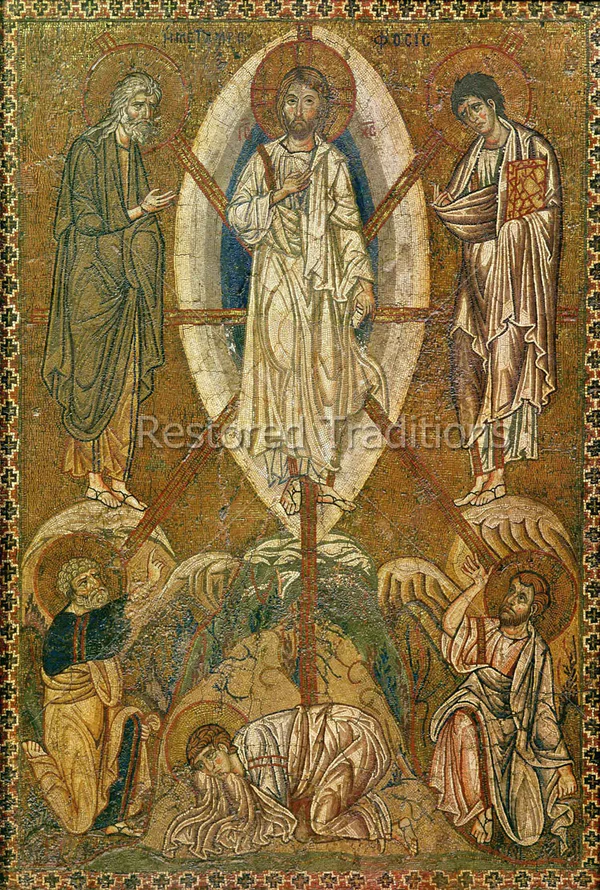
*Transfiguration of Christ.
This is a twelfth-century Byzantine mosaic image of the Transfiguration of Our Lord on Mount Tabor, during which event the Savior revealed His divine glory to the apostles Peter, James, and John. In the artwork, Christ stands in a halo of light, with Moses and Elijah standing on either side of Him, shedding rays of light upon the awed apostles.
In the New Testament, the Transfiguration of Jesus is an event where Jesus is transfigured and becomes radiant in glory upon a mountain. The Synoptic Gospels (Matthew 17:1–8, Mark 9:2–8, Luke 9:28–36) describe it, and the Second Epistle of Peter also refers to it (2 Peter 1:16–18).
In these accounts, Jesus and three of his apostles, Peter, James, and John, go to a mountain (later referred to as the Mount of Transfiguration) to pray. On the mountaintop, Jesus begins to shine with bright rays of light. Then the Old Testament figures Moses and Elijah appear next to him and he speaks with them. Both figures had eschatological roles: they symbolize the Law and the prophets, respectively. Jesus is then called “Son” by the voice of God the Father, as in the Baptism of Jesus.
Many Christian traditions, including the Eastern Orthodox, Catholic Church, Lutheran and Anglican churches, commemorate the event in the Feast of the Transfiguration, a major festival. In Greek Orthodoxy, the event is called the metamorphosis.
https://en.wikipedia.org/wiki/Transfiguration_of_Jesus
The Transfiguration of Jesus has been an important subject in Christian art, above all in the Eastern church, some of whose most striking icons show the scene.
The Feast of the Transfiguration has been celebrated in the Eastern church since at least the 6th century and it is one of the Twelve Great Feasts of Eastern Orthodoxy, and so is widely depicted, for example on most Russian Orthodox iconostases. In the Western church the feast is less important, and was not celebrated universally, or on a consistent date, until 1475, supposedly influenced by the arrival in Rome on August 6, 1456 of the important news of the breaking of the Ottoman Siege of Belgrade, which helped it to be promoted to a universal feast, but of the second grade. Most notable Western depictions come from the next fifty years after 1475, reaching a peak in Italian painting in the 1510s.
The subject typically does not appear in Western cycles of the Life of Christ, except for the fullest, such as Duccio’s Maestà, and the Western iconography can be said to have had difficulty finding a satisfactory composition that does not merely follow the supremely dramatic and confident Eastern composition, which in Orthodox fashion has remained little changed over the centuries.
https://en.wikipedia.org/wiki/Transfiguration_of_Jesus_in_Christian
I have swept away your offenses like a cloud, your sins like the morning mist. Return to me, for I have redeemed you.
Is 44:22