
Saint Sixtus II, & Companions & Saint Cajetan
Lives of the Saints
by Alban Butler, Benziger Bros. edition
[1894]
August 7.—ST. CAJETAN.
CAJETAN was born at Vicenza, in 1480, of pious and noble parents, who dedicated him to our blessed Lady.
From childhood he was known as the Saint, and in later years as “the hunter of souls.” A distinguished student, he left his native town to seek obscurity in Rome, but was there forced to accept office at the court of Julius II. On the death of that Pontiff he returned to Vicenza, and disgusted his relatives by joining the Confraternity of St. Jerome, whose members were drawn from the lowest classes; while he spent his fortune in building hospitals, and devoted himself to nursing the plague-stricken.
To renew the lives of the clergy, he instituted the first community of Regular Clerks, known as Theatines. They devoted themselves to preaching, the administration of the sacraments, and the careful performance of the Church’s rites and ceremonies.
St. Cajetan was the first to introduce the Forty Hours’ Adoration of the Blessed Sacrament, as an antidote to the heresy of Calvin.
He had a most tender love for our blessed Lady, and his piety was rewarded, for one Christmas eve she placed the Infant Jesus in his arms.
When the Germans, under the Constable Bourbon, sacked Rome, St. Cajetan was barbarously scourged, to extort from him riches which he had long before securely stored in heaven.
When St. Cajetan was on his death-bed, resigned to the will of God, eager for pain to satisfy his love, and for death to attain to life, he beheld the Mother of God, radiant with splendor and surrounded by ministering seraphim. In profound veneration, he said, “Lady, bless me!” Mary replied, “Cajetan, receive the blessing of my Son, and know that I am here as a reward for the sincerity of your love, and to lead you to paradise.” She then exhorted him to patience in fighting an evil spirit who troubled him, and gave orders to the choirs of angels to escort his soul in triumph to heaven. Then, turning her countenance full of majesty and sweetness upon him, she said, “Cajetan, my Son calls thee. Let us go in peace.” Worn out with toil and sickness, he went to his reward in 1547.
Reflection.—Imitate St. Cajetan’s devotion to our blessed Lady, by invoking her aid before every work.
Saint Sixtus II, Pope, and Companions, Martyrs; Saint Cajetan, Priest Nm 11:4b-15/Mt 14:13-21 (407) Pss II.
https://www.ewtn.com/catholicism/saints/cajetan-510
CATHOLICISM SAINTS ST. CAJETAN
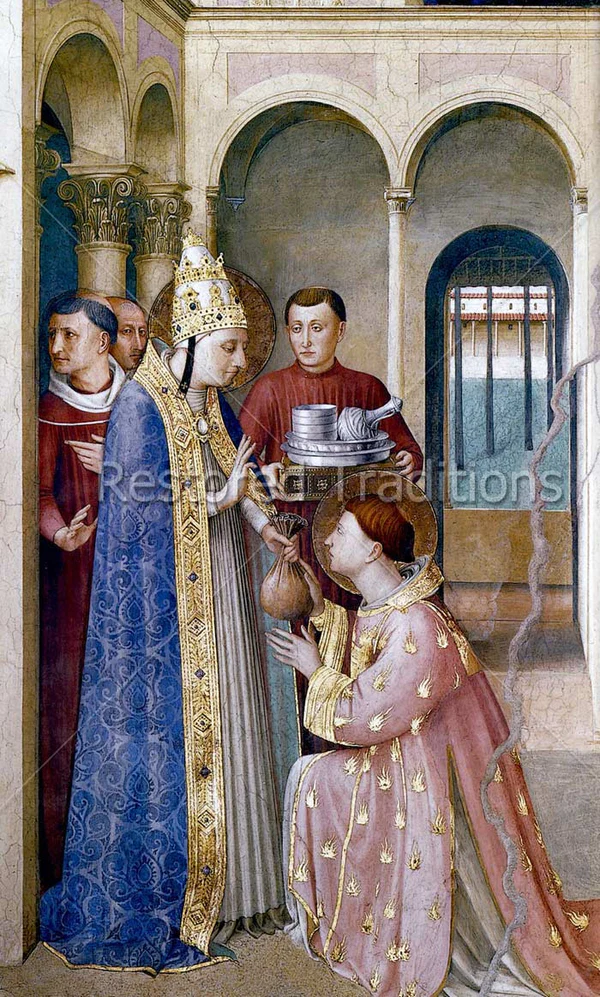
*Sts. Sixtus & Lawrence – Angelico
The full title of this artwork by Fra Angelico: is Pope Saint Sixtus Consigning the Goods of the Church to St. Lawrence.
*Pope Sixtus II, also written as Pope Xystus II, was bishop of Rome from 31 August 257 until his death on 6 August 258. He was martyred along with seven deacons, including Lawrence of Rome, during the persecution of Christians by the Emperor Valerian.
https://en.wikipedia.org/wiki/Pope_Sixtus_II
**Gaetano dei Conti di Thiene (6 October 1480 – 7 August 1547), known as Saint Cajetan (/ˈkædʒətən/), was an Italian Catholic priest and religious reformer, co-founder of the Theatines. He is recognized as a saint in the Catholic Church, and his feast day is 7 August.
https://en.wikipedia.org/wiki/Gaetano_dei_Conti_di_Thiene#:~:text=Gaetano%20dei%20Cont
Believe in the light while you have the light, so that you may become children of light.
Jn 12:36