![CosmicDrama5<span style="color:red;">[NEW]</span>](https://catholicartcollection.com/wp-content/uploads/2025/04/Thumbnail-0008.jpg.webp)





*Sacred Scripture* Christ in the Storm – Rembrandt
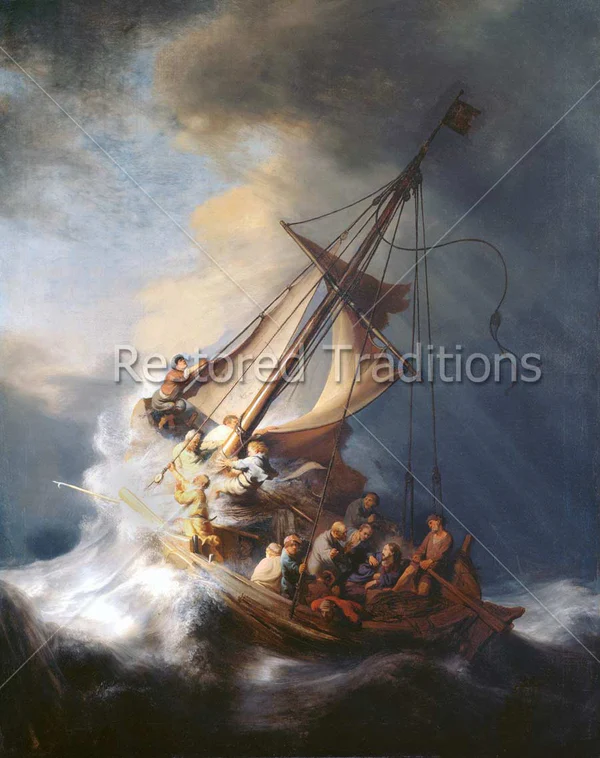
This stirring image by Rembrandt shows Jesus Christ being awakened by his apostles in their storm-tossed boat.
Mk 4:39-41
The Calming of a Storm at Sea.
39He woke up, rebuked the wind, and said to the sea, “Quiet! Be still!”* The wind ceased and there was great calm.
40Then he asked them, “Why are you terrified? Do you not yet have faith?”
41* n They were filled with great awe and said to one another, “Who then is this whom even wind and sea obey?”
https://bible.usccb.org/bible/mark/4
REMBRANDT VAN RIJN (LEYDEN, 1606 – 1669, AMSTERDAM)
CHRIST IN THE STORM ON THE SEA OF GALILEE, 1633
COMMENTARY
Rembrandt’s most striking narrative painting in America, Christ in the Storm on the Sea of Galilee, is also his only painted seascape. Dated 1633, it was made shortly after Rembrandt moved to Amsterdam from his native Leiden, when he was establishing himself as the city’s leading painter of portraits and historical subjects. The detailed rendering of the scene, the figures’ varied expressions, the relatively polished brushwork, and the bright coloring are characteristic of Rembrandt’s early style. Eighteenth-century critics like Arnold Houbraken often preferred this early period to Rembrandt’s later, broader, and less descriptive manner.
The biblical scene pitches nature against human frailty – both physical and spiritual. The panic-stricken disciples struggle against a sudden storm, and fight to regain control of their fishing boat as a huge wave crashes over its bow, ripping the sail and drawing the craft perilously close to the rocks in the left foreground. One of the disciples succumbs to the sea’s violence by vomiting over the side. Amidst this chaos, only Christ, at the right, remains calm, like the eye of the storm. Awakened by the disciples’ desperate pleas for help, he rebukes them: “Why are ye fearful, O ye of little faith?” and then rises to calm the fury of wind and waves. Nature’s upheaval is both cause and metaphor for the terror that grips the disciples, magnifying the emotional turbulence and thus the image’s dramatic impact.
The painting showcases the young Rembrandt’s ability not only to represent a sacred history, but also to seize our attention and immerse us in an unfolding pictorial drama. For greatest immediacy, he depicted the event as if it were a contemporary scene of a fishing boat menaced by a storm. The spectacle of darkness and light formed by the churning seas and blackening sky immediately attracts our attention. We then become caught up in the disciples’ terrified responses, each meticulously characterized to encourage and sustain prolonged, empathetic looking. Only one figure looks directly out at us as he steadies himself by grasping a rope and holds onto his cap. His face seems familiar from Rembrandt’s self-portraits, and as his gaze fixes on ours we recognize that we have become imaginative participants in the painter’s vivid dramatization of a disaster Christ is about to avert.
Saying the holy name of Jesus is the simplest way of praying always.
1-A prayer from Raphael the Archangel:
*While you are on this earth, you must praise the Lord God and give him thanks.
2-A prayer from Tobit and Tobias:
*They began to sing hymns of praise, giving thanks for all the mighty deeds God had done while his angel Raphael had been with them.
3-A simple Jesus prayer:
*Lord, Lord, Jesus Christ…Son of God…have mercy on me…Be kind to others…Work Hard…Be joyful.
4-Another prayer:
*When all that God asks of us is to be quiet and keep ourselves at peace-attentive to the secret work He is beginning in our souls-Be Empty and See That I Am God.
The Sovereign Lord has given me a well-instructed tongue, to know the word that sustains the weary. He wakens me morning by morning, wakens my ear to listen like one being instructed.
Is 50:4