![CosmicDrama5<span style="color:red;">[NEW]</span>](https://catholicartcollection.com/wp-content/uploads/2025/04/Thumbnail-0008.jpg.webp)





*Sacred Scripture* Christ and St. Mary Magdalene at the Tomb – Rembrandt
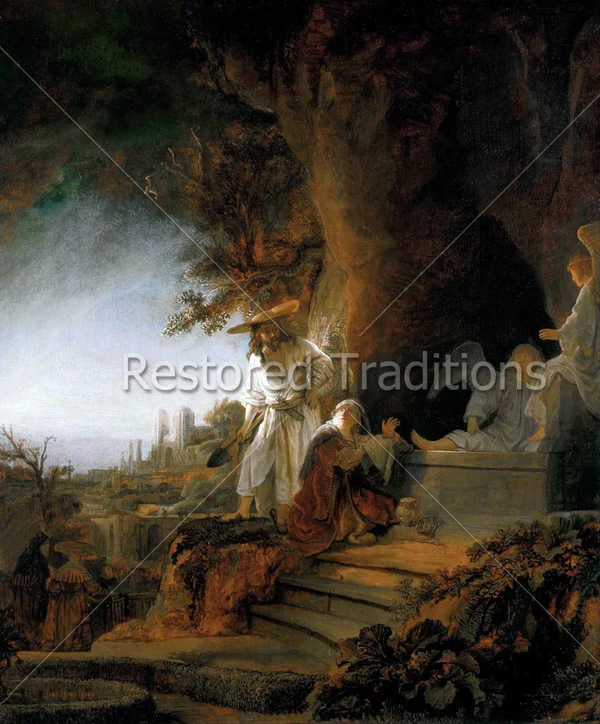
After Jesus rose from the dead, He appeared to Mary Magdalene. This image, by Rembrandt, shows the Risen Christ, dressed as a gardener and holding a shovel, speaking with an astonished Magdalene, while angels sit on and around the opened tomb.
*Christ and St Mary Magdalene at the Tomb reveals how imaginatively Rembrandt could interpret traditional religious subject-matter. The scriptural source for this scene is the Gospel of St John (20:11-18), who describes in some detail the burial and subsequent resurrection of Christ following the Crucifixion. Mary Magdalene returns to the tomb early the next morning, only to find the stone at the entrance removed and two angels inside it where the body should have been. She then fetches two of the disciples, who check that the tomb is empty and then leave her. The angels then ask Mary Magdalene, ‘Woman, why weepest thou?’ and she replies, ‘Because they have taken away my Lord, and I know not where they have laid him.’ At that moment she turns round and sees a man dressed as a gardener, not appreciating that he is the resurrected Christ. She appeals to him for information, but he calls her by her name and she instantly recognizes him. (‘Jesus saith unto her, Mary. She turned herself, and saith unto him, Rabboni; which is to say master.’) Rembrandt has depicted the moment of realization just before the actual recognition. Most artists chose to paint the next moment in the text, when Mary Magdalene reaches out towards Jesus and he forestalls her with the words ‘Touch me not’ (in Latin, Noli me tangere).
Rembrandt skillfully evokes the dawn as the opalescent light picks out from the darkness the towers of the Temple of Jerusalem, the upper half of the figure of Christ, the face of Mary Magdalene, and the outline of one of the angels in the tomb. This use of light is almost symbolic in both the physical and the spiritual senses. The paint is in general thinly applied and, apart from the treatment of the light and the vegetation around the tomb referring to Christ’s activities as a gardener, could almost be described as monochrome. It is only after a time that the eye focuses on the two female figures (the Gospels of St Mark and St Luke refer to three Maries at the tomb) in the middle distance on the left descending the hill.
Of particular note is the positioning of Christ, who in the relationship established between his partially silhouetted vertical form and the Temple of Jerusalem behind and the rocky cave next to him dominates the composition, whereas the twisting pose of Mary Magdalene is the pivot. The tension created between Christ’s standing figure and the twisting kneeling Mary Magdalene is palpable. The artist’s only other treatment of the subject of Christ and Mary Magdalene is in Brunswick (Herzog Anton Ulrich Museum): it is dated 1651 and is totally different in composition.
Signed and dated indistinctly on the tomb on the right: ‘Rembrandt ft. 1638’
** The day after the Crucifixion, Mary Magdalene found Christ’s tomb empty. Two angels spoke to her as she wept, and when she turned she saw a man she thought was a gardener. Rembrandt sticks closely to the passage in the Gospel of John, which poses the question of the risen Christ’s appearance, because Mary Magdalene recognizes neither his face nor his voice. The figure of Christ eludes understanding, and the rising sun symbolizes the dawn of a new era for mankind.
Rembrandt (Rembrandt Harmenszoon van Rijn) (1606 – 1669)
1638
Oil on wood – H. 61 cm; W. 49.5 cm – Signed and dated on the tomb – Her Majesty Queen Elizabeth II, The Royal Collection, London, RCIN 404816
© 2011 Her Majesty Queen Elizabeth II
Jn 20:11-18
The Appearance to Mary of Magdala.*
11But Mary stayed outside the tomb weeping.f And as she wept, she bent over into the tomb
12and saw two angels in white sitting there, one at the head and one at the feet where the body of Jesus had been.
13And they said to her, “Woman, why are you weeping?” She said to them, “They have taken my Lord, and I don’t know where they laid him.”
14When she had said this, she turned around and saw Jesus there, but did not know it was Jesus.g
15Jesus said to her, “Woman, why are you weeping? Whom are you looking for?”h She thought it was the gardener and said to him, “Sir, if you carried him away, tell me where you laid him, and I will take him.”
16Jesus said to her, “Mary!” She turned and said to him in Hebrew, “Rabbouni,”* which means Teacher.
17Jesus said to her, “Stop holding on to me,* for I have not yet ascended to the Father. But go to my brothers and tell them, ‘I am going to my Father and your Father, to my God and your God.’”i
18Mary of Magdala went and announced to the disciples, “I have seen the Lord,” and what he told her.
https://bible.usccb.org/bible/john/20
Saying the holy name of Jesus is the simplest way of praying always.
1-A prayer from Raphael the Archangel:
*While you are on this earth, you must praise the Lord God and give him thanks.
2-A prayer from Tobit and Tobias:
*They began to sing hymns of praise, giving thanks for all the mighty deeds God had done while his angel Raphael had been with them.
3-A simple Jesus prayer:
*Lord, Lord, Jesus Christ…Son of God…have mercy on me…Be kind to others…Work Hard…Be joyful.
4-Another prayer:
*When all that God asks of us is to be quiet and keep ourselves at peace-attentive to the secret work He is beginning in our souls-Be Empty and See That I Am God.
The life appeared; we have seen it and testify to it, and we proclaim to you the eternal life, which was with the Father and has appeared to us.
1 Jn 1:2