![CosmicDrama5<span style="color:red;">[NEW]</span>](https://catholicartcollection.com/wp-content/uploads/2025/04/Thumbnail-0008.jpg.webp)





*Sacred Scripture* Madonna of the Chair – Raphael
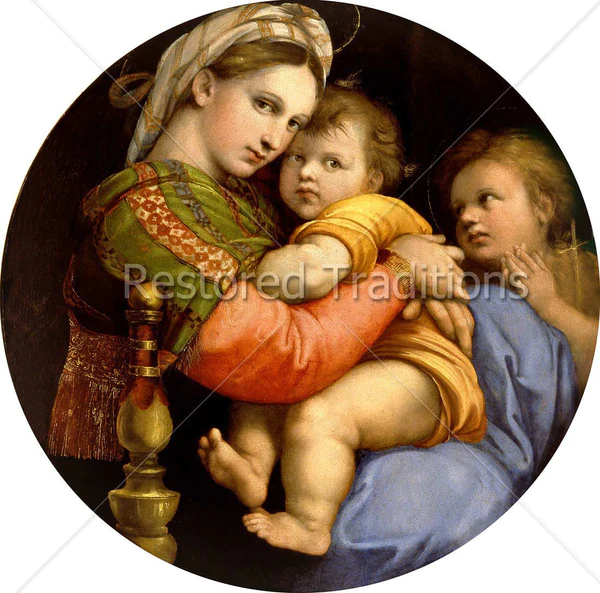
The Virgin Mary holds the Child Jesus Christ in her arms, while a young John the Baptist looks on. Artwork by Raphael.
*The Madonna of the Chair, painted by Raphael in 1514, is perhaps one of Raphael’s most well known and loved Madonna pieces. The original painting was done in a circular tondo format, which is imitated in the painting itself. The positioning of the images and the directional gazes of Our Blessed Mother protectively cuddling the infant Jesus and the admiring look of St. John the Baptist, depicted as a child, emphasize a circular direction to the piece. This particular print of the Madonna of the Chair comes set in an ornate rectangular gold frame under non-glare glass.
**The Madonna of the Chair
The Madonna Della sedia commonly known as the Madonna of the chair is a painting by an Italian artist Raphael dating back to 1513 -1514. It is currently housed in the Palazzo Pitti collection, Florence.
The painting depicts Mary, the mother of Jesus embracing a young child who is the Christ, while John the Baptist devoutly watches. This artistic work was executed during the Roman period. It does not have a strict geometrical form and the linear style of his Florentine treatments of the similar subject. Instead, its warmer colors seem to show the influence of the famous Titian and his rival Sebastiano Del Piombo.
His earliest techniques and paintings coincided with the increasing use of oil paint in his country, Italy. Most of his paintings executed on the panel seem to use the paint. Also, in many of his offerings, Raphael used egg tempera, which was a mixture common with various artists of his generation.
Before settling in Rome, most of his paintings were executed on animal skins or a piece of paper. In his artistic work, he used a medium that was a type of watercolor in which its pigments were bound in animal glue. Before settling on his colors, Raphael performed several experiments with the oil medium and watercolor in order to achieve the beautiful color variations, richer colors and the greater depth of shadow. While working on the Madonna of the chair, Raphael employed several assistants before having talented pupils and associates.
His technique and style changed significantly while in Florence, and he used pen and ink to complete this painting. Most of the work was rougher, and his large and complex color compositions were regarded as the classic arts of a high Renaissance. During this period, Raphael had to learn the Florentine methods of creating up a combination with the pyramidal figure masses. They were then brought together as independent units, but they retained their original shape. The unity of the composition and the suppression of the inessentials is what differentiate the appearance of the painting. The style he used provides a unique and highly idealized depiction of the entire forms represented in the painting.
In many paintings, including the Madonna of the chair, Raphael looked to design and develops calmer and extroverted style which would serve as famous and universally accessible forms of visual communications.
This paint provides or delivers a vivid image of Mary, John the Baptist and baby Jesus with maximum color accuracy and the exceptional resolution. The painting engages you or any other viewer directly as Mary sits closely confined within a circular format affectionately and carefully cuddling her young one, the infant Jesus Christ. On the right of the Madonna, the child Raphael depicts John the Baptist who is Christ’s younger cousin. He painted this work while in Rome, and the child was added shortly after his work on Vatican Stanza. The Madonna of the chair was taken by Napoleon’s troops in the year 1799 before being returned to Florence in the year 1815.
Praise awaits you, our God, in Zion; to you our vows will be fulfilled. You who answer prayer, to you all people will come.
Ps 65:1–2