![CosmicDrama5<span style="color:red;">[NEW]</span>](https://catholicartcollection.com/wp-content/uploads/2025/04/Thumbnail-0008.jpg.webp)





*Sacred Scripture* Descent from the Cross – Rubens
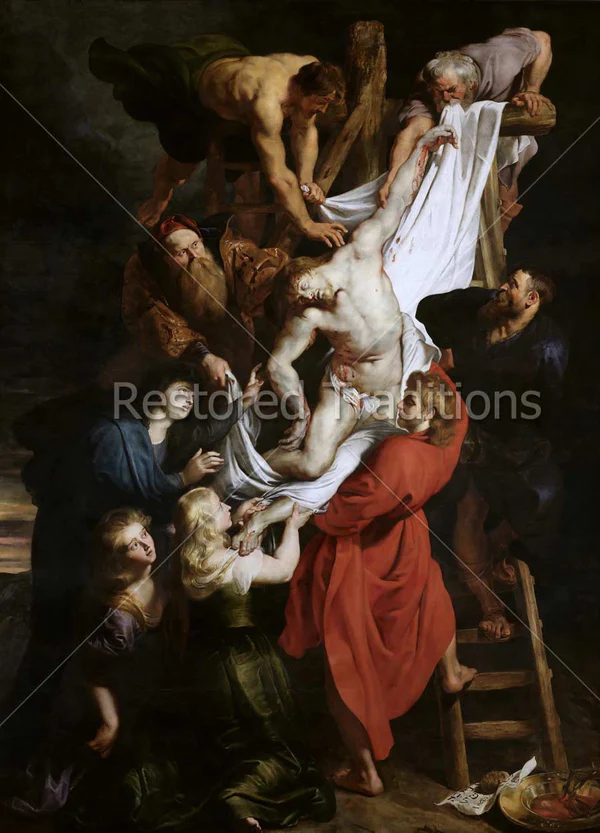
Jesus Christ is taken down from the Cross after His Crucifixion on Mount Calvary, in this painting by P. P. Rubens.
Inspiration for Rubens’ Descent From the Cross
Detail from Laocoon and His Sons
One of the fascinating aspects of Art History is tracing how a new generation of artists re-interpret and expand on the work of those who came before them. All artists draw inspiration from their predecessors. In Art History we refer to this as a “quotation.” For instance, early in the 15th century the ancient Greek sculpture, Laocoon and His Sons, was discovered, and artists journeyed to Rome to sketch and study the sculpture. Laocoon was believed to embody human suffering, particularly as it is expressed in the human body, and became the template and model for many of the Renaissance masterpieces.
It is believed Rubens modeled his Nicodemus after the son on the right of the Laocoon statue. In particular the eyes and eyebrows express the distress as each stare up in sorrow and distress.
The other influence Rubens is believed to have drawn from was Daniele da Volterra’s Descent From the Cross. Comparing Volterra’s work with Rubens we can see the elements that Rubens has incorporated; the ladders, John holding Christ, the two men leaning over the cross. Also noteworthy in terms of tracing influences is that Volterra’s work is believed to be based on sketches by Michelangelo, who Volterra knew well.
We can see that Rubens’ Christ figure has the same sculptural feel as Michelangelo and Volterra. While the two works are very distinct and different, Rubens was not copying Volterra, so perhaps this is less a quotation of Volterra’s work as a translation of it into a new artistic language.
Additionally, we can see the influence of Caravaggio on Rubens work. While we often speak of Caravaggio’s use of light, it is just as illuminating to flip the conversation and speak of his use of darkness. Caravaggio was known for his black, or dark backgrounds that created the backdrop for his dramatic use of light, often from a single source.
Rubens has pulled in what he learned from Caravaggio and used the darkness around Christ to metaphorically speak to the dark night the world is descending into with the death of the Christ. With this dark, foreboding background, the areas that are lit, particularly the white shroud and Christ’s body, stand out in stark relief.
https://www.kellybagdanov.com/2021/03/19/peter-paul-rubens-descent-from-the-cross-triptych/
Descent From the Cross
The Descent from the Cross has a discipline and restraint that clearly distinguishes it from the energy that exudes from the Raising of the Cross, painted just 2 years before.
The composition of the Descent is simplified, the light is concentrated, the figures grouped along a unifying line on a flat plane. The movement in the scene is deliberate, careful, and gentle. A surrounding blackness contrasts with the blanched diagonal that is washed in a mysterious, heaven-sent shaft of light.
Only the essentials are here: two wooden ladders, and on the ground at the lower right is the superscription held down by a rock, and a brass bowl containing the crown of thorns, the nails, and blood.
Peter Paul Rubens, Descent From the Cross (1612) Center panel detail
Crucifixion was usually a slow and tortured death, with breath sometimes lingering for two days. It was the Roman custom to then leave crucified corpses to the carrion birds, and later to throw the remains into a communal grave. But Jewish law required that the body be buried before sunset on the day of death, and his followers knew this was particularly important for Jesus, for it was the eve of the Sabbath, and moreover, the Sabbath of Passover. (Note the waning light of day at the left margin.)
The Gospels of John and Mark tell us that Joseph of Arimathea obtained permission from Pilate to bury Jesus, and with Nicodemus and two servants, went to take him down from the cross. There he met St. John the Evangelist and the three Marys, and together they removed the nails from his hands and feet and lowered him in a linen winding sheet to the ground.
Rubens’ Descent includes only this intimate group of eight prescribed followers. Their intense engagement in this loving undertaking serves to concentrate the viewer’s emotional response. There’s nothing expendable, no unnecessary figures or secondary scenes to distract our attention from this grievous moment in time.
The simplicity and unity of the composition establish the eloquent poignancy of the event. It’s a testament to Rubens’ extraordinary skill that he could convey such tenderness and devotion without any hint of sentimentality.
When the Lord restored the fortunes of Zion, we were like those who dreamed. Our mouths were filled with laughter, our tongues with songs of joy. Then it was said among the nations, “The Lord has done great things for them.” The Lord has done great things for us, and we are filled with joy.
Ps 126:1–3